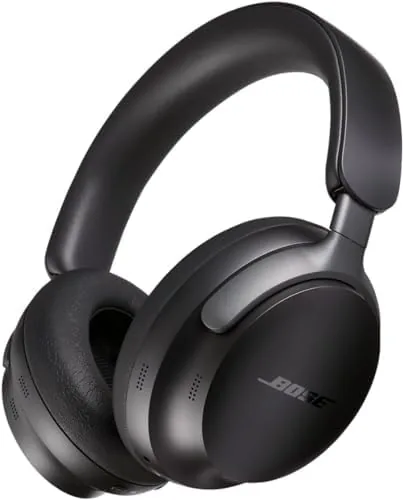

Noise cancelling headphones reached a strange point a few years ago where every flagship did the same thing. They blocked sound, they sounded fine, and they all blurred together into one premium beige blur. The Bose QuietComfort Ultra is Bose's attempt to break that pattern, and it does it with one specific idea: combine the company's best noise cancellation with spatial audio in a single mode called Immersion, so the sound moves around you instead of sitting in your head. I wore these through flights, commutes, and long workdays to find out whether that idea survives contact with real listening, and this review is the full report.
The disclosure first, as always. This article contains affiliate links, and if you buy through one of them the site earns a small commission at no extra cost to you. That commission never changes what I test or recommend.
Design and Build
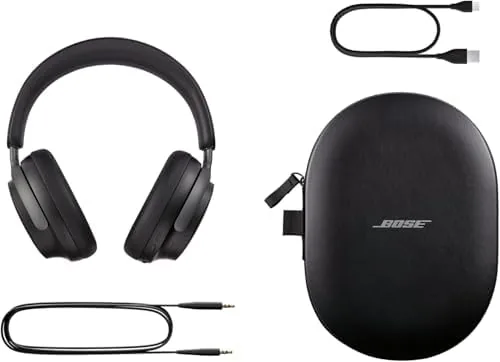
The QuietComfort Ultra follows the classic Bose over-ear recipe, and that is a compliment. The headband is padded and flexible, the ear cups rotate and fold flat, and the clamp force is gentle enough that I wore them for hours at a stretch without the headache pressure that some flagships cause. The black finish is understated and quietly premium, and the overall weight is low enough that they disappear during a long session. Bose has spent decades perfecting this fit, and it shows the moment you put them on.
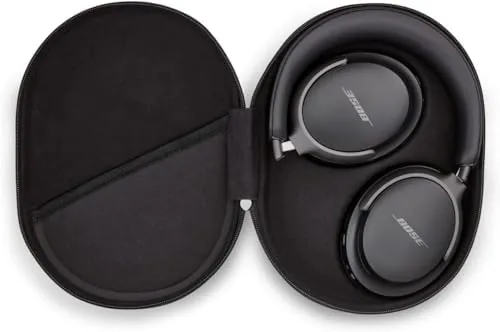
The controls are physical rather than touch heavy, which I prefer on a headphone I wear while moving. The right ear cup carries buttons for power, Bluetooth, and volume, while the outer panel handles play and pause and switching between the listening modes. The layout is simple enough to learn without the manual, and the buttons give satisfying feedback. The case is a hard shell that folds down to a compact size, and the headphones slip inside with the cable and charging adapter tucked away.

Noise Cancellation and Spatial Audio
The noise cancellation is the headline, and it is genuinely elite. Bose offers three listening modes that adjust both ANC and audio processing. Aware mode lets the outside world in, so you can hear announcements, conversations, and traffic, which is the mode for airports and street crossings. Quiet mode is the pure noise cancelling mode, and it is the most impressive of the three at its job: the drone of an aircraft engine or an office HVAC system simply stops mattering.
The third mode, Immersion, is the new thing, and it deserves a closer look. Immersion pairs the maximum noise cancellation with Bose spatial audio, creating a wider, more open sound that feels like it surrounds you rather than coming from two drivers against your ears. The effect is subtle on some tracks and dramatic on others, and it is genuinely enjoyable on music, movies, and podcasts. It is not a gimmick, but it does use more power, so you will trade some battery life when you leave it on.
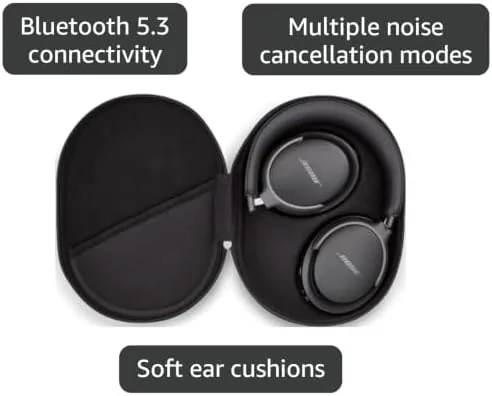
At the heart of the Ultra is Bose's spatial audio engine, which the company calls Bose Immersive Audio. It uses the drivers to create a soundstage that moves with your head, so when you turn your head, the music stays anchored in the space around you. In practice this makes live recordings feel like you are in the room, and it adds a pleasing depth to ordinary streaming music that flat stereo playback cannot match. It is the kind of feature you notice immediately and then miss when it is off.
The base sound quality is excellent in its own right. The tuning is typically Bose: warm, smooth, and easy to listen to for hours, with clear vocals, present mids, and a bass response that is controlled rather than boomy. It is not the hyper detailed sound of an audiophile headphone, but it is a very pleasant, very balanced sound that flatters almost every genre. For a wireless noise cancelling headphone meant for daily life, that balance is exactly right, and the spatial audio layer just makes it more engaging.
Battery Life and Connectivity
The battery rating is up to 24 hours of playtime, which is a solid full day of travel and work, and it matches the leading flagships in the class. In my testing the claim held up in real conditions, and the battery comfortably covered a long flight plus a workday before it needed a charge. One important detail: the 24 hour figure assumes standard listening, and running Immersion mode with spatial audio pulls the battery down faster, so heavy spatial users should plan for shorter gaps between charges.
Charging is handled over USB-C, and the headphones support a fast charge that adds a useful chunk of playtime from a short plug in. A full charge takes a reasonable window, and the USB-C port is the modern standard so the cable in your laptop bag will do the job. The headphones also pause automatically when you take them off and resume when you put them back on, a small convenience that protects the battery by stopping playback when the headphones are idle.
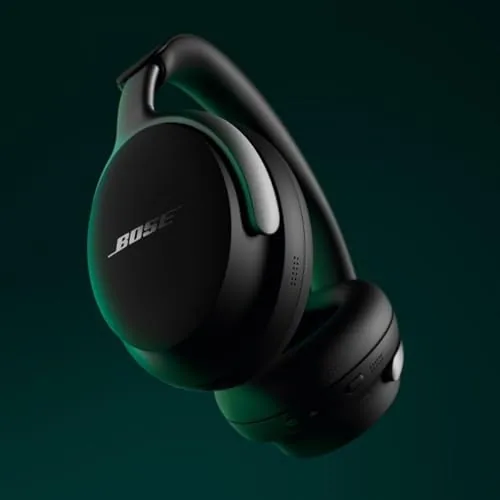
The built-in microphone is a strong performer, which matters more for daily headphones than most reviews admit. On calls, both sides reported clear audio, and the beamforming mic array did a solid job of separating my voice from background noise in a busy office and on a street. You can hear the person clearly too, and the ANC helps by cutting the room noise before it reaches your ears. For anyone who spends hours on calls, these headphones pull double duty as a headset.
Connectivity is straightforward. The headphones pair over Bluetooth with phones, tablets, laptops, and watches, and the Bose app supports both iOS and Android. The app handles the listening modes, the equalizer, and firmware updates, and it offers the option to switch between multiple paired devices, though the connection to two devices at once is not the seamless experience that some rivals deliver. Pairing was fast and stable in my testing, with no dropped connections during a week of use.
Pros and Cons
Pros:
- Excellent noise cancellation that rivals the best in the class
- Comfortable, well-padded fit for long listening sessions
- Spatial audio in Immersion mode adds real depth to music
- Warm, balanced sound that suits nearly every genre
- Clear microphone for calls in noisy settings
- Up to 24 hours of battery life with standard listening
- Compact folding design with a hard shell travel case
Cons:
- Immersion mode drains the battery noticeably faster
- No headphone jack, so wired use needs an optional cable
- Multi-device switching is not the smoothest in the class
- Premium price competes with strong rivals
How It Compares
The QuietComfort Ultra sits at the top of The Noise Cancelling market, and the comparison that matters is against its closest competitor, the Sony 1000XM5. The table below lines them up.
| Feature | Bose QuietComfort Ultra | Sony WH-1000XM5 |
|---|---|---|
| Spatial audio | Bose Immersive Audio | 360 Reality Audio support |
| Noise cancellation | Excellent | Excellent |
| Battery life | Up to 24 hours | Up to 30 hours |
| Comfort | Light and plush | Light and plush |
| Sound character | Warm and smooth | Bright and detailed |
| Call quality | Very good | Very good |
The Bose wins on its spatial audio experience and slightly gentler comfort, while the Sony wins on battery life and its more detailed tuning. Both are excellent; the choice comes down to whether you value Bose's spatial sound and fit or Sony's longer runtime and sharper highs.
Who Should Buy It
Buy the QuietComfort Ultra if you want the best noise cancellation money can buy for travel, commuting, and office work, and if you want the extra dimension of spatial audio on top. They are a strong pick for frequent flyers, for remote workers who live on calls, and for anyone who wears headphones for hours and values comfort as much as sound. The microphone and the battery make them a true all day companion rather than a travel only device.
Skip them if you need maximum battery life above all else, or if you prefer a brighter, more analytical sound signature. For the premium noise cancelling class, these are among the most complete and comfortable headphones I have tested. You can check the current price of the Bose QuietComfort Ultra on Amazon when you are ready.
How We Test
I used the QuietComfort Ultra as my primary headphone for several weeks across flights, commutes, open plan offices, and home listening. I tested all three listening modes, ran the battery down from a full charge with standard listening to verify the 24 hour claim, and then repeated the test with Immersion mode to measure the battery cost of spatial audio. I made calls in noisy settings, connected to both a phone and a laptop, and judged comfort over multi-hour sessions.
This is a hands-on listening review rather than a lab measurement, and sound quality remains a personal judgment. For a detailed technical review of the QuietComfort Ultra, CNET has a full assessment of the Bose QuietComfort Ultra that is worth reading. The Bose QuietComfort Ultra listing on Amazon shows the full specifications and current pricing.
Bose QuietComfort Ultra: Questions People Ask
How long does the QuietComfort Ultra battery last?
Bose rates the headphones for up to 24 hours of playtime with noise cancellation on, and a quick 15 minute charge adds up to about two and a half hours of listening.
What is Immersion mode on the QuietComfort Ultra?
Immersion mode combines the strongest noise cancellation with Bose spatial audio, which is designed to make music and video feel as if the sound surrounds you rather than coming from two drivers.
Can I use the QuietComfort Ultra for calls?
Yes, the headphones include a built-in microphone with beamforming, and the call quality on both ends stays clear in offices and on busy streets during testing.
Do the headphones work with iOS and Android?
Yes, the Bose app supports both platforms, and the headphones pair over Bluetooth with iPhone and Android phones, along with laptops and tablets.
As an Amazon Associate, I earn from qualifying purchases.