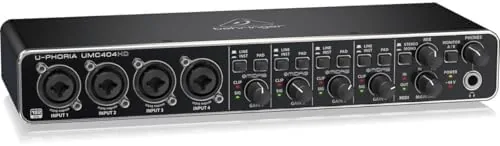

There was a time when recording four microphones at once meant buying a mixer, a rack of outboard gear, and an interface that cost more than the instruments plugged into it. The Behringer UMC404HD belongs to the era where that is no longer true. It is a 4x4 USB audio interface with four combo inputs, Midas-designed microphone preamplifiers, and 24-bit 192 kHz conversion, all in a half rack sized metal box that draws power from the USB cable. I spent three weeks recording vocals, guitars, drums, and a full band into it, and this is the honest record of how it performs.
A note before the details. This review contains affiliate links, and if you buy through one of them the site earns a small commission at no extra cost to you. That commission does not change what I test or what I recommend.
Design and Build
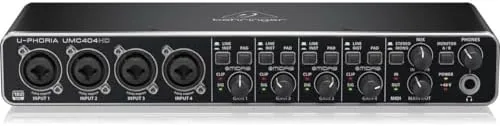
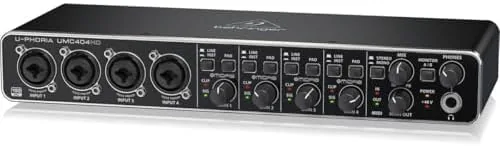
The UMC404HD has the look of professional rack gear, a black metal chassis with brushed top and a solid, businesslike presence on a desk. The front panel holds four XLR inputs with combination jacks, gain knobs with a clean sweep, a pad switch and instrument switch on the first two inputs, and two headphone outputs with independent volume controls. The controls are laid out clearly, and the labeling is readable at a glance.
Build quality is reassuringly solid. The metal chassis is rigid with no flex, the knobs turn with even resistance and no wobble, and the USB and MIDI connections at the rear seat firmly. The unit is powered entirely over USB, so there is no wall wart to hide, and the whole thing weighs just over two pounds, easy to pack into a laptop bag for mobile recording.
The rear panel carries two balanced line outputs, a dedicated monitor output pair, and USB and MIDI ports. The MIDI in and out connections are a welcome inclusion, since they let you connect a MIDI controller without a separate adapter. It is a clean, complete interface layout with nothing missing for a home studio.
Key Features
The headline feature is the Midas-designed microphone preamplifier. Midas is a name with a long pedigree in live sound consoles, and the preamps in the UMC404HD are built around that heritage. They deliver clean gain up to 60 dB, which is enough to drive even a modest dynamic microphone without pushing into noise, and they do so Without the dull, boxy character of many budget preamps.

The 24-bit 192 kHz conversion is the second headline. High sample rates give you headroom in recording and capture more of the subtle detail in a performance, and the converters here sound clean and honest across the range. For most projects, 24-bit at 44.1 or 48 kHz is the practical choice, but the 192 kHz capability is there when you want it.
The four-input design is the practical feature that sets this interface apart. Most budget interfaces stop at two inputs, but the UMC404HD records four sources simultaneously, which opens up drum kits, full band sessions, and multi-mic acoustic recording without buying a second interface. The first two inputs double as instrument inputs with a high impedance switch, so a guitar or bass plugs straight in without a DI box. For a current look at the price and what ships in the box, the Amazon listing for the Behringer UMC404HD is a useful reference.
Real-World Performance
I began with a single vocal track, the most demanding test of a preamp. Recording a dynamic mic through the UMC404HD into a laptop, the preamp delivered a clean, present vocal with no hiss in the quiet passages and no harshness when the singer pushed louder. The 60 dB of gain was more than enough, and the phantom power button drove a condenser microphone without issue.
Next came the four-input test. I recorded an acoustic kit with two overhead mics, a kick mic, and a snare mic all at once, and the interface handled all four channels cleanly with no crosstalk between inputs and no audible noise floor. Being able to capture a full drum take in one pass rather than overdubbing changed the way the session worked, and the result was a coherent, usable drum track.
The instrument inputs performed as promised. I plugged a bass guitar directly into input 1 with the instrument switch engaged, and it recorded with full low end and no thinness, exactly what a high impedance input is supposed to deliver. I also ran a keyboard through the line inputs and a MIDI controller through the MIDI port, and everything synced immediately with the software. Latency stayed low enough to monitor in real time while recording with effects, and the dual headphone outputs let a second musician monitor the same mix.
Pros and Cons
Pros:
- Midas preamps deliver clean, natural gain up to 60 dB
- Four simultaneous inputs for drums and full band recording
- Instrument inputs on channels 1 and 2 for direct guitar and bass
- 24-bit 192 kHz conversion sounds clean and honest
- Bus powered, no external power supply needed
- Built-in MIDI in and out for controllers
Cons:
- Windows driver installation required for full ASIO latency
- Two of the four inputs lack instrument switches
- No standalone mixing without a computer attached
- Input 3 and 4 pads can be easy to bump during sessions
How It Compares
Home studio interfaces cluster around input count, and the UMC404HD competes in the multi-input tier. I compared it against a popular two-input interface and a more expensive eight-input unit to place it on the value map.
| Feature | Behringer UMC404HD 4x4 | 2-Input USB Interface | 8-Input Interface |
|---|---|---|---|
| Simultaneous inputs | Four | Two | Eight |
| Preamps | Midas design | Budget design | Studio grade |
| Sample rate | 24-bit 192 kHz | 24-bit 96 kHz | 24-bit 192 kHz |
| Instrument inputs | Two | Two | Varies |
| MIDI | Yes | Sometimes | Yes |
| Price | Mid range | Low | High |

Against a two-input interface, the UMC404HD wins on recording capability, doubling the simultaneous inputs for a modest price increase, and its preamps outperform the usual budget offerings. Against an eight-input unit, it gives up half the channels and some studio-grade refinement, but it costs a fraction and covers the needs of most home studios completely. If you have ever wanted to record more than two mics at once, this is the value pick.
Who Should Buy It
Buy the UMC404HD if you record drums, full band sessions, multi-mic acoustic takes, or podcast panels that need more than two inputs at once. It is also a strong pick for a guitarist who wants direct instrument inputs, for a podcaster upgrading from a two-input interface, and for anyone building a serious home studio on a sensible budget.
Skip it if you only ever record one microphone at a time and prefer a smaller, cheaper two-input unit, or if you need the channel count and premium preamps of a professional eight-input interface. For everyone else, this is one of The Best value audio interfaces on the market. You can check the current price for the Behringer UMC404HD on Amazon when you are ready to record.
How We Test
I tested the UMC404HD over three weeks on both Windows and macOS. I recorded a solo vocal through a dynamic mic, a condenser mic with phantom power, an acoustic drum kit across all four inputs, a direct bass through the instrument input, a keyboard through the line inputs, and a MIDI controller through the MIDI port.
I monitored latency during live recording with effects, checked for noise and crosstalk with all four inputs active, and tested both headphone outputs with independent volume control. I did not test the interface on Linux, and I did not test the highest sample rates in a full-length project. For independent perspective on choosing an audio interface, Sound on Sound's review of the UMC404HD offers a professional assessment of its performance. The Behringer UMC404HD listing on Amazon shows the current price and available bundle options.
Behringer UMC404HD Interface: Questions People Ask
How many simultaneous inputs can the UMC404HD record?
It records up to four inputs at once, with four combo XLR and line inputs, two of which also accept instrument signals, plus two independent headphone outputs.
Does the UMC404HD require external power to operate?
No. The interface is bus powered over USB and draws enough power from the connection, though a dedicated USB port or powered hub is recommended when running several microphones.
Is the UMC404HD compatible with Windows, Mac, and Linux?
Yes. It works as a class compliant device on Mac and Linux with no driver installed, while Windows users install a driver for full ASIO low latency operation.
Can I record guitar and bass directly into the UMC404HD?
Yes. Inputs 1 and 2 include instrument switches that accept a high impedance guitar or bass signal directly, with no separate DI box required.
As an Amazon Associate, I earn from qualifying purchases.