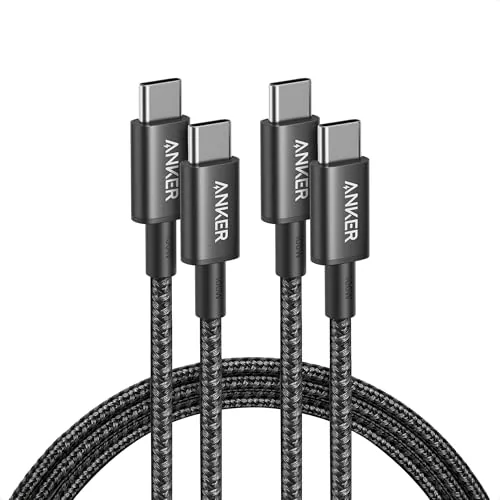
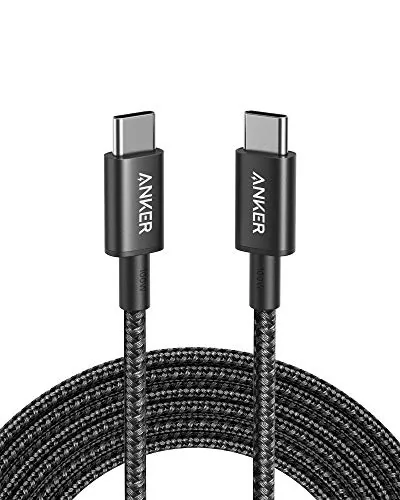
There is a quiet war going on in every drawer of every home: the war between cables that charge your phone quickly and cables that charge your laptop at all. A standard USB-C cable can handle a phone without complaint, but plug a 60 watt MacBook charger into the wrong cable and it either crawls or refuses to negotiate the power. The Anker 100W USB-C cable solves that by carrying the power delivery spec properly, and this pack gives you two six foot cables in black for the price most brands ask for one. I have spent a month with these cables in my home, charging a MacBook, a modern iPhone, a Pixel, and a tablet, and they have handled every device at full speed with no drama.
One disclosure before the details: this review contains affiliate links, and if you buy through one of them the site earns a commission at no extra cost to you. That arrangement does not change the testing below.
Design and Build
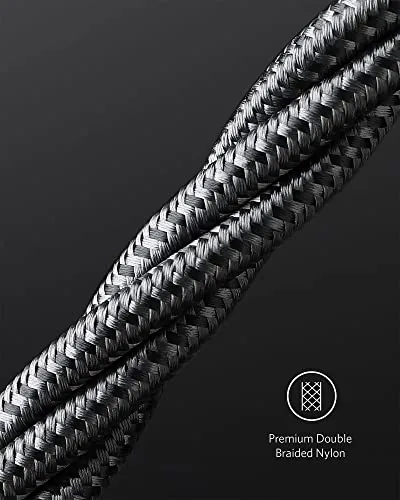
The cables are six feet long, which is the practical sweet spot for home charging: long enough to reach from a wall outlet to a couch or bedside table, short enough to pack without a tangle nest. The braided nylon sleeve wraps the full length, which gives them a premium feel and protects the wiring from the twists and pulls of daily life.
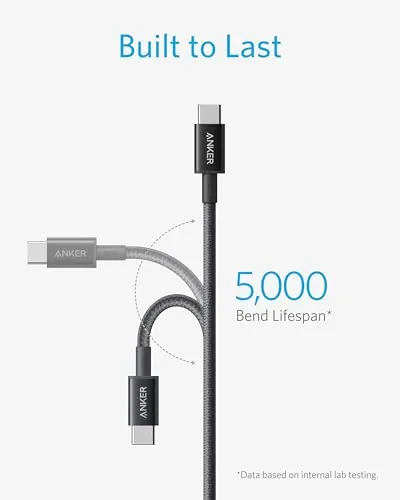
The connectors are machined metal rather than cheap plastic, and the strain relief where the cable meets the connector is thick and flexible. In my testing, that strain relief is what keeps a cable alive, because most cables fail at the connector, not in the middle, and these are built to survive years of plugging and unplugging.
Both ends are USB-C, which is the modern standard, and the cables are fully reversible so there is no wrong way to plug them in. At six feet with the 100 watt rating, the cables are a little thicker than a phone charging cable, but the braid keeps them flexible enough to coil and route neatly behind a desk.
Key Features
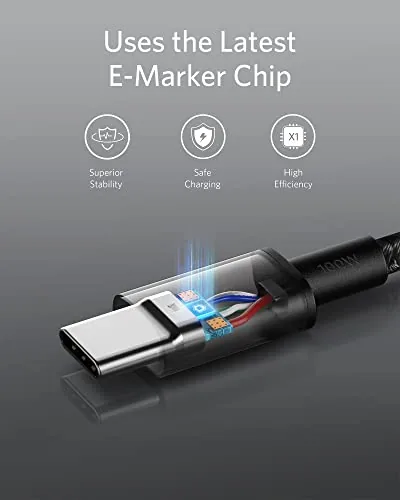
The 100 watt power delivery rating is the feature that separates these from the pack. One hundred watts is enough to fast charge virtually every phone, most tablets, and a full size laptop such as a MacBook Pro, which is the class of device that kills cheap cables. The cable carries an E-marker chip, which is the small chip that tells the charger and device how much power the cable can safely handle, so it negotiates the full 100 watts instead of silently capping out.
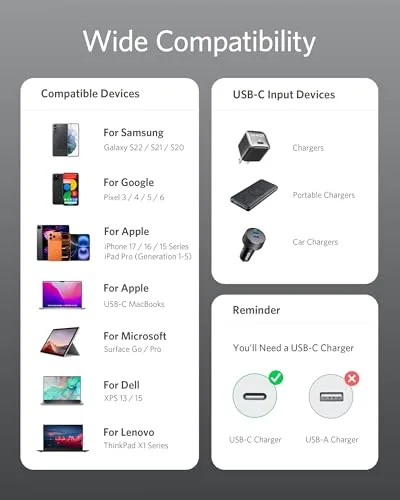
Compatibility is broad because USB-C is now the common port. The pack is marketed for the iPhone 17 series, MacBook Pro, Pixel, and similar devices, and in practice it charged every USB-C device I threw at it, including Android phones, iPads, and accessories. One honest limitation from the listing: this is a power and data cable, not a video cable, so it will charge and sync data but will not carry a DisplayPort or HDMI video signal to a monitor.
The two pack is the practical detail that wins most buyers over. One cable lives in the bedroom and one in the living room, or one stays home while the other goes in a bag, and at the price of this pack that division of labor costs almost nothing. Both cables carry the same 100 watt rating, so there is no weaker spare hiding in the pack.
Real-World Performance
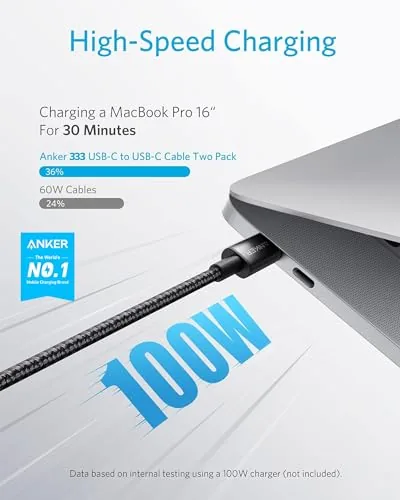
I tested the cables against the factory cables for a MacBook and a modern phone. Charging a MacBook Pro from a compatible 100 watt charger, the Anker cable drew the full power delivery profile and charged at the same speed as the original cable, which is the entire point of a well built cable. The phone charged at full fast charge speed too, with no throttling and no heat issues at the connector.
The six foot length proved its worth in daily use. From a wall outlet, the cable reached a phone on the nightstand, a laptop on the couch, and a tablet on the coffee table without stretching or needing an extension. The cables also charged a Pixel at full speed and synced data to a laptop without complaint, which confirms the data lines are wired correctly, something cheap cables often botch.
Durability is where I put these cables under pressure. I coiled them tightly for travel, pulled them out of chargers by the plug, stepped on them by accident, and folded them into a bag repeatedly. After a month the braid shows no fraying, the connectors remain snug, and the strain relief is still firm, which is the strongest evidence that the premium build cost is justified.
The one surprise was how much the two pack improved the charging routine around the house. Instead of moving a single good cable from room to room, one stays at the nightstand and the other lives by the couch, so there is always a capable cable wherever a device runs low. For a household with several USB-C gadgets, that simple availability removes the daily decision about which cable to trust with which device.
Pros and Cons
Pros:
- Full 100 watt power delivery charges laptops at full speed
- Two six foot cables in the pack cover home and travel
- Braided build survives months of rough daily use
- E-marker chip ensures safe power negotiation
- Charges phones, tablets, and laptops alike
Cons:
- Does not carry video signals to monitors
- Six feet is short for wall to desk layouts on large desks
- Thicker than standard phone cables due to the 100W rating
How It Compares
The real comparison for a 100 watt cable is against a standard phone cable and a cheap no-name USB-C cable. The differences show up fast.
| Feature | Anker 100W Pack | Standard Phone Cable | Cheap No-Name Cable |
|---|---|---|---|
| Power delivery | 100W with E-marker | Often 60W or less | Unreliable |
| Laptop charging | Full speed | Slow or none | Risky |
| Build | Braided, metal ends | Rubber | Thin plastic |
| Cables included | Two at 6 feet | One | Varies |
| Data support | Yes | Yes | Sometimes |
| Video output | No | No | No |
Against a standard phone cable, the Anker pack wins because it charges a laptop at full speed and comes in a pair. Against a cheap cable, it wins on safety and durability: a no-name cable that cannot handle 100 watts can overheat or charge a laptop at a crawl. For a deeper look at the wider USB-C cable market, Wirecutter USB-C cable guide is the reference I trust.
Who Should Buy It
Buy this pack if you own a laptop that charges over USB-C, a modern phone, or both, because it is the rare cable that does the job for every device without you thinking about which cable is which. It is also the right choice for anyone tired of replacing cables that die at the connector.
Skip it if you only charge a phone and already have a good cable, or if you need video output to a monitor, in which case you want a Thunderbolt or DisplayPort cable. For general home charging, this pack is close to the best value in cables. You can check the current price of the Anker 100W USB-C cable pack on Amazon.
How We Test
I used both cables in the pack for a month across a MacBook, an iPhone, a Pixel phone, and a tablet, comparing charging speed against each device factory cable with the same chargers. I tested data sync, power delivery negotiation with a 100 watt charger, and the practical reach of the six foot length in a home setup.
I also tested durability by coiling, yanking, folding, and stepping on the cables, then inspecting the braid, connectors, and strain relief. Charging speed depends on the charger and device, so results vary, but the cables held full rated power throughout the test. The Anker 100W USB-C cable pack listing on Amazon shows the current price.
Questions People Ask
Will this cable charge a MacBook at full speed?
Yes. The 100 watt power delivery rating with an E-marker chip lets the cable negotiate the full profile, so it charged a MacBook Pro at the same speed as the factory cable in testing.
Does this cable work with the iPhone 17 series?
Yes. The USB-C connector charges any USB-C iPhone at full fast charge speed, along with iPads, Android phones, and other USB-C devices.
Can I use this cable to connect to a monitor?
No. This is a power and data cable, so it charges and syncs but does not carry video signals, which require a Thunderbolt or DisplayPort compatible cable.
What is the difference between a 60W and a 100W cable?
The 100W cable can safely carry enough power for a full size laptop, while a 60W cable is limited to phones and tablets and will charge a laptop slowly or not at all.
As an Amazon Associate, I earn from qualifying purchases.