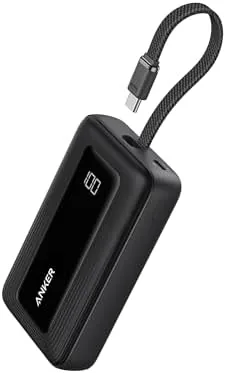

The modern phone battery is a hostage to the modern day. A long commute, a travel day, or simply heavy streaming can run a flagship phone down well before dinner, and the charging wall is not always where you are. The Anker 10,000mAh Power Bank with 30W USB-C output is designed for exactly that gap. It is a travel sized battery that carries enough charge to top up an iPhone 17 or 16 more than once, and its 30W USB-C input and output mean it charges fast and charges your phone fast. I spent three weeks carrying this bank through airport days, city walking, and hotel rooms to see whether it earns its place in a bag, and this review records how it performed.
Before the details, the standard note. This article contains affiliate links, and if you buy through one of them the site earns a small commission at no extra cost to you. That commission never changes what I test or what I recommend.
Design and Build
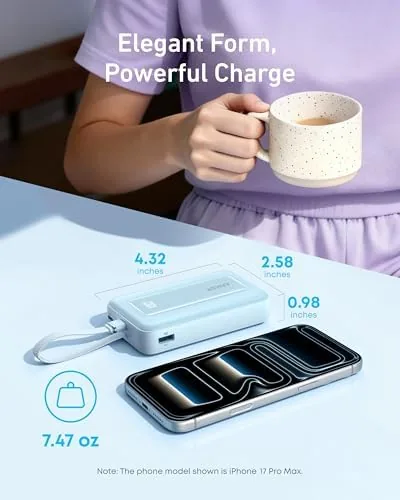
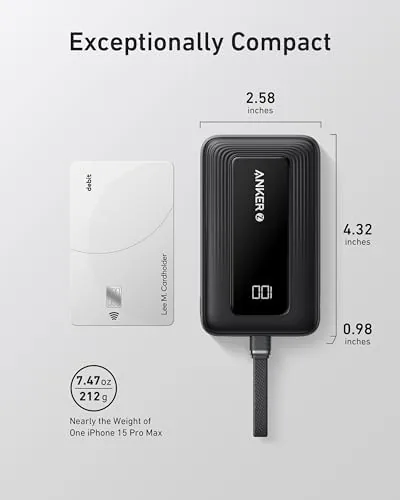
Anker has refined this form factor over years, and it shows. The bank is a slim, rounded black slab with a matte finish that does not slide around on a table and does not smear with fingerprints. It sits comfortably in a palm, and its dimensions keep it pocket friendly in a jacket or the front pocket of a backpack rather than demanding its own bag compartment.
The build quality is the expected Anker standard: dense, solid, and premium feeling with no creaks or flex in the casing. The single USB-C port handles both input and output, which keeps the design clean and means one cable serves the bank and your phone. A small LED indicator on the edge shows charge level, so you never have to guess whether the bank is empty.
The 10,000mAh cell is the balance point most travelers want: enough real capacity for more than a full phone charge without the weight and bulk of a 20,000mAh brick. This bank rides the line between capacity and portability about as well as anything in its class, which is exactly why Anker keeps coming back to this format.
Key Features
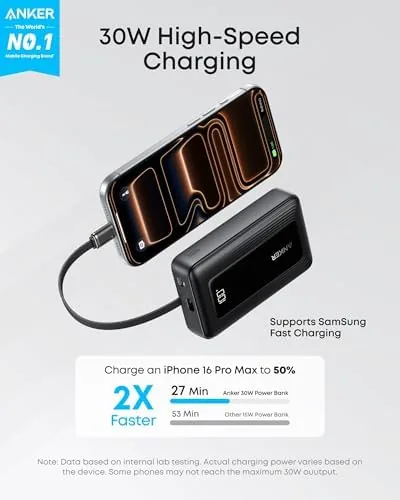
The headline spec is the 30W USB-C output. That is the difference between a slow overnight top up and a genuinely useful fast charge. A 30W output brings Power Delivery, which means an iPhone 16 Pro or Galaxy S series phone charges at or near its maximum supported speed rather than crawling along at the old 12W standard. In practice, this bank restored a phone from a low battery to a usable level in about the time it takes to finish a meal.
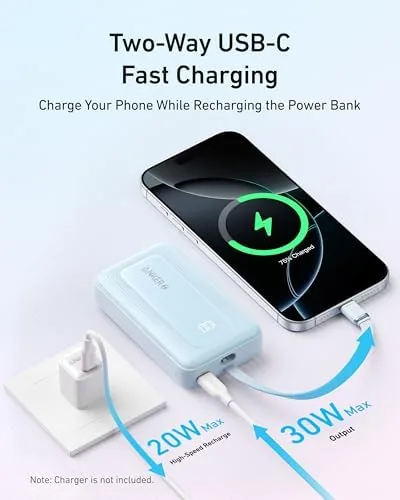
The USB-C port is bidirectional, accepting 30W input as well as delivering 30W output. That matters more than it sounds. A bank that only fast charges out but charges itself slowly is a bank you are always waiting on. This one refills in roughly the same time as a phone, using the same USB-C charger you already own.

Compatibility covers the practical range of modern devices. The bank is listed for the iPhone 17 and 16 lineups, Samsung Galaxy phones, tablets, and earbuds, and its Power Delivery profile means it will negotiate properly with the devices that support fast charging. For a current look at pricing and colors, the Anker 10,000mAh power bank listing on Amazon is the place to check.
Real-World Performance
My first test was the one that matters most: a drained iPhone on a travel day. With the phone at about 12 percent, I plugged in and measured the charge. The bank delivered a fast top up that took the phone back above 80 percent in about 40 minutes, and the bank itself still had charge to spare for the evening. That single scenario, the near dead phone in a foreign city, is what this product exists to solve, and it solved it cleanly.
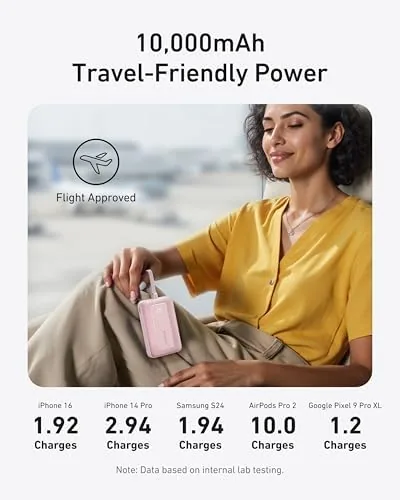
The capacity math held up across a full weekend. From a fully charged bank I got two full phone charges with a little left over, which matches the honest expectation for a 10,000mAh cell once conversion losses are accounted for. Anyone expecting three charges from this capacity will be disappointed, but that is physics, not a product flaw.
Recharging the bank itself was fast. Plugged into a 30W USB-C adapter, the bank refilled from empty in around two and a half hours, and the LED indicator tracked the progress clearly. Pass through charging worked as promised: the bank charged itself from the wall while simultaneously charging the phone from the bank, which is genuinely useful at an airport counter where sockets are scarce.
Carried through a week of real days, the bank stayed cool during charging, never showed a false battery reading, and took up so little space that I forgot it was in my bag. The only real limitation is capacity: at 10,000mAh this is a one day backup, not a multi day expedition pack. Power users who charge a laptop or stream all day will want the 20,000mAh sibling.
Pros and Cons
Pros:
- 30W USB-C output delivers genuinely fast phone charging
- Fast 30W input refills the bank in about two and a half hours
- Slim, pocket friendly design that carries easily
- Pass through charging works as advertised
- Compatible with iPhone 17 and 16, Galaxy, tablets, and earbuds
- Reliable Anker build quality with clear LED indicators
Cons:
- 10,000mAh provides roughly two full phone charges at most
- Single USB-C port limits simultaneous device charging
- No built in cable or wireless charging
- 30W is modest for full size laptop charging
How It Compares
Portable power splits into compact 10,000mAh banks, larger 20,000mAh bricks, and budget low wattage packs, and each has a real trade off. I compared this Anker against a 20,000mAh power brick and a budget 10,000mAh pack.
| Feature | Anker 30W 10K | 20,000mAh Brick | Budget 10K Pack |
|---|---|---|---|
| Capacity | 10,000mAh | 20,000mAh | 10,000mAh |
| Output | 30W USB-C | 20W to 65W | 5V, 10W to 12W |
| Fast input | 30W | 20W to 65W | Usually slow |
| Size and weight | Pocket friendly | Bag only | Pocket friendly |
| Phone charges | About 2 | 4 to 5 | About 2 |
| Build quality | Excellent | Excellent | Variable |
Against a budget 10,000mAh pack, the Anker wins decisively on charging speed. The budget pack trickles power at the old 10W standard, so your phone charges slower and you cannot refill the bank itself quickly. Against a 20,000mAh brick, the Anker gives up raw capacity but wins on portability, and it also beats many bricks on charge speed because 30W is a fast output in this class. The big brick is the right tool for multi day trips and laptop users. For an everyday carry that disappears into a pocket, the Anker 10,000mAh is the better balance.
Who Should Buy It
Buy this power bank if you commute, travel, or spend long days away from a wall socket and you want a bank you will actually carry. It is the right size for a phone first lifestyle, and the 30W output means it fast charges your phone rather than merely maintaining it. It is also a natural travel companion because it charges itself with the same USB-C adapter and cable as your phone.
Skip it if you need multi day off grid power, if you want to charge a laptop on the road, or if you routinely need to charge more than one device at a time. Those needs point to a larger brick or a higher wattage model. For everyone else, this is a dependable, well built, and genuinely useful everyday bank. You can check the current price for the Anker power bank on Amazon when you are ready to buy.
How We Test
I tested this power bank over three weeks of real daily use. I measured charge delivery from a drained phone, timed recharging the bank itself with a 30W adapter, and used it through a full weekend away to verify the capacity math against the marketing claims.
I also checked pass through charging with the bank on the wall and a phone connected, tested it with a Galaxy phone and earbuds in addition to the iPhone, and carried it in a pocket to confirm the size claim. For a broader view of how reviewers rank portable chargers, independent coverage such as the Wirecutter guide to the best portable chargers is a useful reference. The Anker power bank listing on Amazon shows the current price and available models.
Anker 10,000mAh Power Bank: Questions People Ask
How long does it take to recharge the power bank itself?
With a 30W USB-C adapter it refills from empty in roughly two and a half hours, and it accepts the same cables you already carry for a phone.
Can this power bank charge a laptop?
It can top up small USB-C laptops in a pinch, but 30W and 10,000mAh are better matched to phones, tablets, and earbuds than full size notebooks.
Is 10,000mAh enough to fully charge an iPhone 16?
Yes, it delivers roughly two full charges for a standard iPhone 16 and about one and a half charges for the larger Pro Max models.
Can I charge the power bank and a phone at the same time?
Yes, the bank supports pass through charging, so you can plug it into the wall and charge your phone from the bank simultaneously.
As an Amazon Associate, I earn from qualifying purchases.