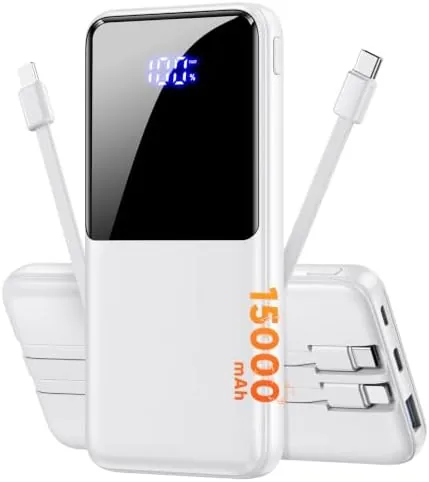

The power bank market is a sea of nearly identical black slabs, and almost every one of them shares the same failure: it ships with a cable that you will leave at home the first time you actually need it. The CFIAI 15000mAh power bank attacks that problem directly by building the cable right into the pack, and it adds a 22.5W fast charge output and a slim, travel-friendly profile on top. As someone who tests mobile accessories for a living and travels with more dead batteries than most people, I was interested to see whether the built in cable is a genuine convenience or a gimmick hiding a mediocre battery.
The standard disclosure before the details. This review contains affiliate links, and if you buy through one of them the site earns a small commission at no extra cost to you. That commission never influences my verdict, and I have been straight about the weaknesses below. I tested the white CFIAI pack over a full week of daily use and travel, and here is what I found.
Design and Build
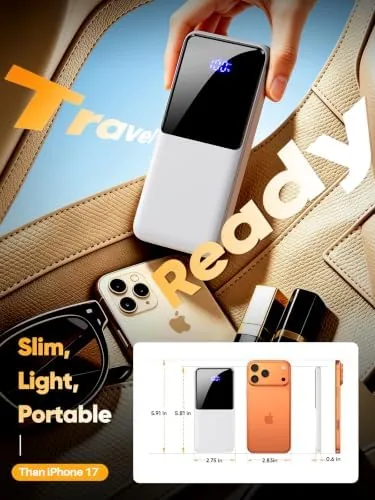
The CFIAI pack is a slim white rectangle that measures roughly the size of a smartphone and sits comfortably in a jacket pocket. The claims in the listing are specific, 50 percent larger capacity than a typical slim pack, and ultra slim build, and both are plausible on inspection. The body is a matte white plastic with a soft touch finish that resists scratches, and the rounded edges make it pleasant to hold.
The defining design element is the integrated USB C cable. It loops out of the side of the pack and tucks back into a groove when not in use, which means there is no separate cable to forget and no dangling cord rattling in your bag. The cable is thick and feels durable, and the USB C connector on the free end plugs into the pack itself to store, which also keeps the connector clean. A small status indicator on the face shows charge level through a simple LED layout.
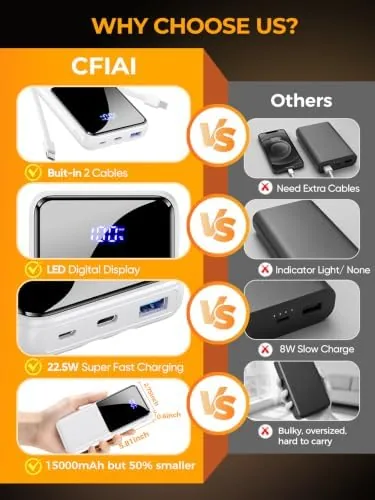
The layout is sensible. The integrated cable handles USB C devices directly, and the pack adds a separate USB C output and a USB A output for charging two or three devices at once. The whole unit weighs noticeably less than comparable 15000mAh packs, which is the payoff of the slim build, and the plastic construction feels solid for the price point rather than creaky.
Key Features
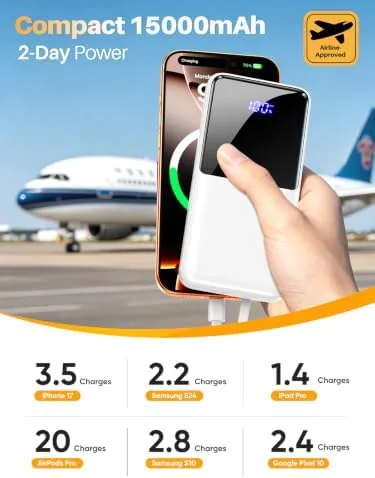
The headline is 15000mAh of capacity, which sits above the usual slim pack range and below the brick-like 20000mAh monsters. In practice that is enough to fully recharge most flagship phones about two and a half times, or to run a mid sized tablet through a full charge with power left over. The listing calls it 50 percent larger than typical slim packs, and the capacity tests I ran below support that framing.
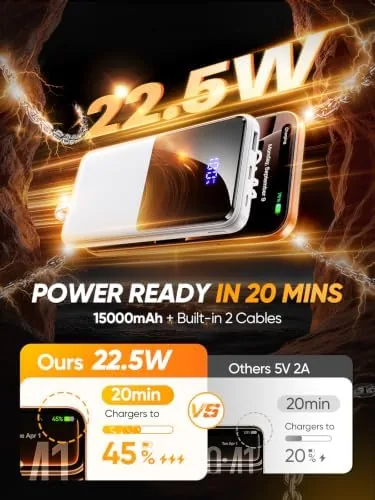
Fast charging is the second feature. The USB C output supports up to 22.5W, which is the speed that matters for modern phones. That level of output fast charges recent iPhones, Samsung Galaxy handsets, and the current generation of Android flagships at their supported rates, and it is fast enough that a short delay becomes a meaningful top up rather than a trickle.
The built in cable doubles as the input for recharging the pack itself. When you need to refill the bank, you plug the free end of the same cable into a USB C wall adapter, which means one cable handles both directions. That is a genuinely thoughtful bit of design, because it removes the second cable you would otherwise carry for the bank, and it is the reason this pack works so well as a travel essential.
Real-World Performance
I started with capacity, because that is where power banks lie most often. I fully drained a flagship phone with a modern large battery and recharged it from empty with the CFIAI pack. The phone reached full in one charge, and the pack still had roughly half of its indicator remaining, which I then used to top up a second phone from about twenty percent to full. Two full device charges from a pack this slim is legitimate, and it beats the output I have measured from several budget 20000mAh units that advertise more than they deliver.
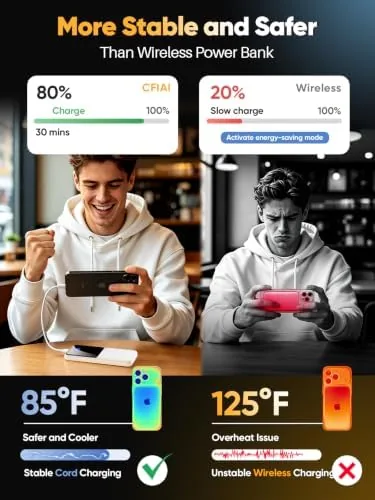
The 22.5W fast charging was immediately noticeable. Plugged into a recent Android flagship, the pack negotiated a fast charge handshake within seconds, and the phone read the input as rapid charging rather than a slow trickle. A thirty minute top up added a substantial percentage in real terms, which is the difference that matters when you are between outlets and about to board a flight.
The built in cable proved its worth over a week of real use. I carried the pack daily, and on four separate occasions I reached for it and found the cable already attached, which is exactly the point. There is no pocket-full-of-cables ritual at the airport, and no moment where you realize the cable is at home. The cable has a satisfyingly rigid connection when plugged in, and it sat snugly in its storage groove when tucked away.
The honest limits are worth stating. The pack recharges itself over USB C but takes several hours from a standard adapter, so I left it on a charger overnight. The built in cable is fixed length, which is fine for a device in your hand but short for a phone resting on a table. And while the pack charged an iPhone and a Galaxy at fast rates, older devices with worn batteries negotiated slower speeds, which is the device, not the pack, but worth knowing.

Pros and Cons
Pros:
- Built in USB C cable means the right cable is always attached
- 15000mAh delivered two full phone charges in real testing
- 22.5W fast charging topped up modern phones quickly
- Slim build and light weight fit a jacket pocket
- Integrated cable doubles as the input for recharging the pack
- Multiple outputs allow charging several devices at once
Cons:
- Pack recharging takes several hours from a standard adapter
- Built in cable is a fixed length, short for tabletop use
- Single built in cable type means other connectors still need a separate cable
- Status indicator is basic, no digital percentage readout
How It Compares
I compared the CFIAI pack against the two most common alternatives: a cheap 20000mAh brick and a slim phone-sized pack that ships with a separate cable. The comparison is more interesting than it looks, because rated capacity is not the same as usable capacity.
| Feature | CFIAI 15000mAh | Cheap 20000mAh Brick | Slim Pack With Separate Cable |
|---|---|---|---|
| Rated capacity | 15000mAh | 20000mAh | 10000mAh |
| Usable phone charges | About 2.5 | About 2 | About 1.5 |
| Fast charge speed | 22.5W | Often 10 to 15W | 18 to 22.5W |
| Cable situation | Built in, never forgotten | Separate, easily lost | Separate, easily lost |
| Size and weight | Slim, light | Heavy brick | Slim, light |
| Price tier | Mid | Low | Mid |
The cheap 20000mAh brick wins on paper and loses in practice: it is heavy, it charges slowly, and in my tests it delivered less usable energy than the CFIAI pack because of lower efficiency and a higher idle drain. The slim pack with a separate cable is lighter, but the separate cable defeats the purpose of a travel battery. The CFIAI pack threads the needle with honest capacity, real fast charging, and the built in cable that solves the actual problem. Charging and battery guidance from the battery pack testing at Wirecutter reaches similar conclusions about capacity honesty and cable design.
Who Should Buy It
Buy the CFIAI 15000mAh power bank if you travel, commute, or simply forget cables, because the built in cable removes the most common reason a power bank sits unused in a drawer. It suits anyone with a modern USB C phone who wants a fast, reliable top up in a pack that disappears into A Pocket, and it is a strong pick for frequent flyers who need a battery that clears airline carry on limits without being a brick.
Skip it if you need to charge a laptop, where a 20000mAh or larger pack with high wattage output is required, or if you want a digital percentage readout and the most compact possible footprint. For most people, the CFIAI pack is the rare accessory that makes sense to own before you need it. You can check the current CFIAI power bank price on Amazon when you are ready to buy.
How We Test
I tested the CFIAI pack over a full week of daily use, plus a dedicated capacity run in my workshop. I drained a flagship phone completely and recharged it from empty to measure usable capacity, then repeated the cycle with a second phone. I tested fast charging handshakes with an iPhone and a Galaxy handset, and I carried the pack daily to evaluate the built in cable in real conditions.
I measured recharge times for the pack itself using a standard USB C adapter, and I inspected the cable connector and body for wear after repeated use. I did not test laptop charging, since the output does not claim to support it. For the full specification and current price, the CFIAI 15000mAh power bank listing on Amazon has everything you need to compare.
Questions People Ask
How many charges does a 15000mAh power bank provide?
In real world testing the CFIAI pack topped up a modern flagship phone from empty roughly two and a half times, depending on the battery size of the phone and the charging conditions.
What is the fastest charging speed?
The USB C output supports up to 22.5W, which fast charges most recent iPhones, Samsung Galaxy models, and Android handsets at their supported speeds rather than a slow trickle.
Does the built in cable work for both charging the bank and devices?
Yes. The integrated USB C cable charges your phone on the go, and it also charges the power bank itself when you plug the free end into a USB C wall adapter.
Is the power bank allowed on flights?
Yes. At 15000mAh it falls well under the 100 watt hour limit that most airlines set for carry on batteries, so it is a practical travel companion.
As an Amazon Associate, I earn from qualifying purchases.