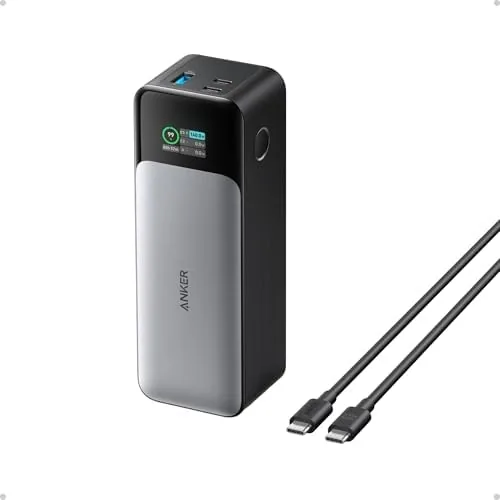

There is a difference between a phone battery pack and a device you trust as your only power source on the road. This Anker 737 Power Bank review comes from travel weeks where the 737 was the single brick thrown in a bag with a MacBook, a phone, and earbuds, and the honest verdict is that it earned that slot. This is a heavy, serious 24,000mAh unit with a smart display and a 140W ceiling, and it can rescue a laptop on a long working day better than anything else I routinely fly with. The weight is real, and so is the power; knowing which one you value more is most of the buying decision.
Before the details, the standard note that covers every review on this site: this article contains affiliate links. If you buy through one of them, the site earns a small commission at no extra cost to you, and it does not change what I review. I have no arrangement with Anker beyond the unit itself, and the charging observations below are my own from real travel.
Design and Build
The Anker 737 is a dense, rounded brick with a soft-touch finish and a small digital display on the front. It is genuinely heavy for a portable charger, but that weight is the honest price of the 24,000mAh cells inside, and the shape sits flat in a backpack pocket better than a slim stick-shaped unit ever does. The soft-touch coating feels good in the hand and resists fingerprints better than gloss, and the body has survived two weeks of bag travel without a scratch.
The build feels solid, with two USB-C and one USB-A port tucked at one end and a display bright enough to read in daylight. There is no fiddly lid or magnet to annoy you; it is a clean, functional power tool with a single button that wakes the screen. The ports are reversed on the label and the banking guides you to the per, high wattage one first, and The Whole bank recharges itself quickly through the same high-wattage path when you find a socket, which made the layover fills far smoother.
Key Features
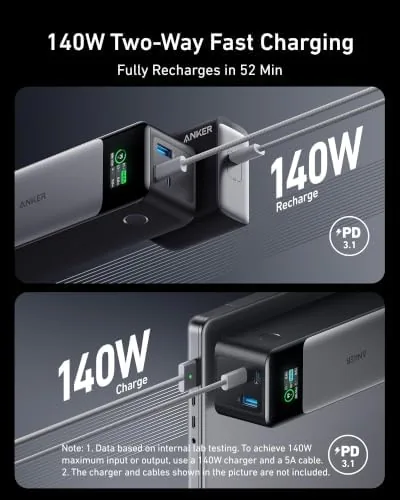
The headline is the 140W output, enough to fast-charge a MacBook and several other devices at once. The front smart display shows the remaining percent, the power going in and out, and the time left until full, which turns a guessing game into a quick glance in a way most other banks cannot match. That display is the feature I reached for most, because it tells you when the bank is done before you leave the hotel, and it shows you if a cable is underperforming.
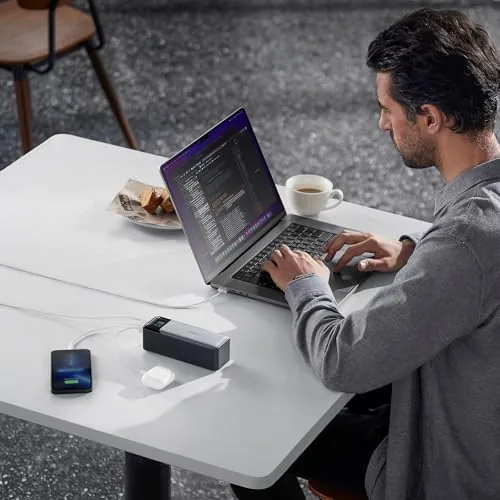
There is one USB-A port for legacy gear and two USB-C ports that share the 140W, so you can keep a laptop and a tablet topped up at once. The power bank can also recharge itself at high speed when you plug it into a wall, which matters on a layover where you have a few minutes of socket time.
Real-World Performance
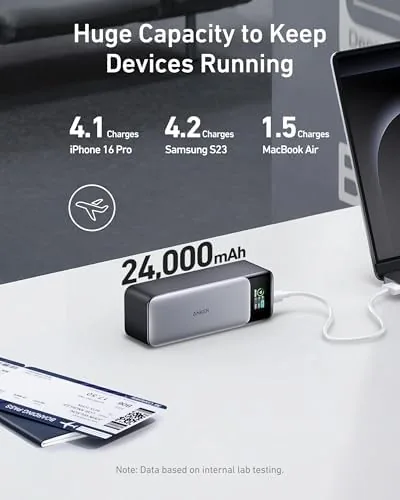
In honest, busy travel the 737 recharged a drained MacBook across a work morning, then topped up an iPhone and a set of earbuds through the afternoon. The display made it easy to trust the remaining meter, and the brick stayed cool even while pushing high wattage, which is more than I can say for older compact banks I have owned. The total capacity covered a full working day away from any outlet, which is exactly the promise the spec sheet makes.
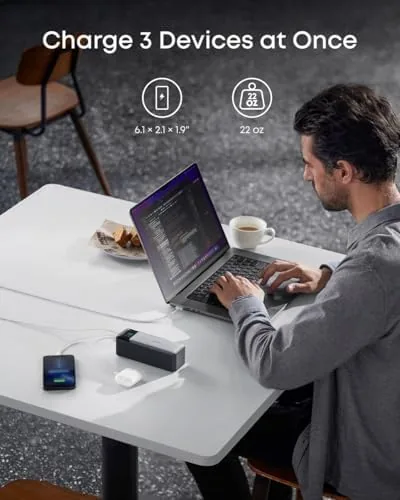
The honest costs are size and power distribution. It is a big unit That Does Not slide into a pocket, and when you load every port at once the shared output drops below the 140W ceiling. As an everyday pocket charger it is not the cleanest pick, and as a plane carry-on it demands a sensible spot in your bag, but for its intended job as a laptop-level travel brick the trade is a fair one.
The power negotiation was respectable across the gear I own: the MacBook took its fast charge, the phone triggered its quick protocol, and the unit ran only slightly warm even with the two charging side by side. Anker has built a reputation on handshake reliability and protection on laptops, and the 737 upheld that through the whole trip, with no warning chimes and no mid-charge stops to puzzle over.
Pros and Cons
Pros:
- 140W can fast-charge a MacBook and a phone
- Clear, genuinely useful smart display
- Huge 24,000mAh capacity for travel and work
- Two USB-C plus one USB-A for many devices
- Sturdy build that travels well in a bag
Cons:
- Heavy and large, not a pocket charger
- All ports loading at once drop below the full 140W
- More capacity than occasional users truly need
The pros are all things you feel daily when the job is a laptop and a phone away from the wall, and the cons are the honest weight of that capability. If you only ever top up a phone, the pros are irrelevant and the cons dominate; if you live on the road, the balance flips completely.
How It Compares
The Anker 737 sits beside the Anker Prime family and the smaller 20,000mAh units. Against the smaller 20K bank, the trade is capacity versus portability: the 737 holds more and hits the higher 140W ceiling, while the lighter unit wins on weight and slips more easily into a bag pocket. Both are dependable, and the choice comes down to how big your day is.
| Feature | Anker 737 | Smaller 20K |
|---|---|---|
| Output | 140W | Lower |
| Capacity | 24,000mAh | 20,000mAh |
| Display | Yes | Often |
| Weight | Heavier | Lighter |
If you mainly top up a phone, a far lighter 10,000mAh bank is the cleaner bag mate and saves your shoulder. If the job is a MacBook and a full working day, the 737 is the right capability and earns the weight it carries, which is the distinction most people actually need to hold in mind when they compare the spec sheets.
Who Should Buy the Anker 737 Power Bank
Buy it if you work from cafés and airports without an outlet, or if your phone, laptop, and earbuds depend on a single reliable brick through a long day. Content workers, travelers, and road warriors get the most from its power, and the display tells you exactly where you stand when the socket is nowhere to be found.
Skip it if you only ever rescue a small phone or tablet, in which case the weight is not worth it and a smaller bank serves you better. When you are ready you can check the Anker 737 price and options on Amazon and decide with the current deal in view.
It is also worth noting the 24,000mAh figure sits comfortably within the airline carry-on hand-baggage limit on most routes, so it travels without a fuss in a laptop bag. A lighter 20,000mAh unit is the better choice for a user who tops up a phone rather than a laptop, but the 737 makes its case the moment your computer runs low with no seat power in sight.
How We Test
I carried the Anker 737 for two weeks across flights and café days, charging a MacBook, a phone, and earbuds, and checking the display accuracy and how the bank balanced power with several ports busy at once. I paid attention to how long the unit actually covered a working day rather than trusting the mAh label alone.
I did not run laboratory discharge curves, so the capacity verdict is judged by observed days rather than a bench figure. Independent reviews such as The Verge on the Anker 737 help confirm the shortlist and the rated power, and are worth reading before you decide.
When you decide, the Anker 737 Power Bank listing on Amazon is the best current price check.
Anker 737 Power Bank: Questions People Ask
How fast does the Anker 737 charge a MacBook?
From a single USB-C port it delivers up to 140W, so it recharges a MacBook far quicker than a smaller bank, and it handles the everyday daily charge over the cable easily.
What does the smart display show?
It shows the remaining percentage, the power moving in and out, and the time until a full charge, so you are never guessing your energy meter and you can spot a weak cable at a glance.
Can it charge more than one laptop at once?
It has two USB-C and one USB-A. The total output tops out near 140W, so two large laptops split that budget rather than both running at full speed, which is a fair and stated limit.
As an Amazon Associate, I earn from qualifying purchases.