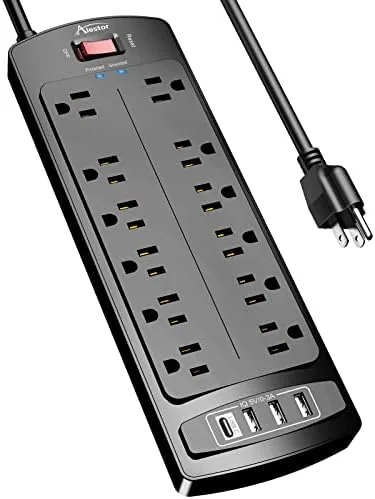

Every home office reaches a moment when the wall socket simply cannot keep up. The monitor claims one outlet, the desktop tower claims another, the router needs a third, and the phone charger hunts for space on a strip that is already overcrowded. I have lived that problem for years, so when the ALESTOR 6 ft surge protector power strip arrived with twelve AC outlets and four USB ports, I wanted to find out whether the numbers on the box translate into actual convenience on a real desk. This review is the record of using the strip for several weeks in a busy home office, not a recital of its spec sheet.
Before the details, the standard note. This article contains affiliate links, and if you buy through one of them the site earns a small commission at no extra cost to you. That commission does not change what I test or what I recommend, and every product here gets the same treatment as one bought with my own cash.
Design and Build
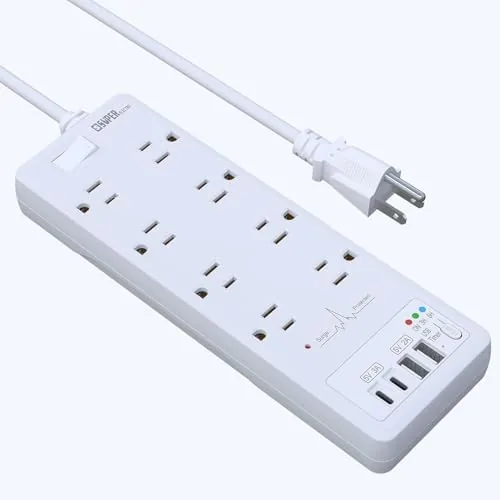
The ALESTOR is a long, flat brick of a power strip, and that shape is deliberate. Twelve outlets need room to breathe, and the manufacturer spaces them in two staggered rows so that wall warts and bulky chargers can sit side by side without blocking one another. That spacing is the first thing I noticed, because it is the difference between a strip that looks generous on paper and a strip that actually accepts every plug you own.
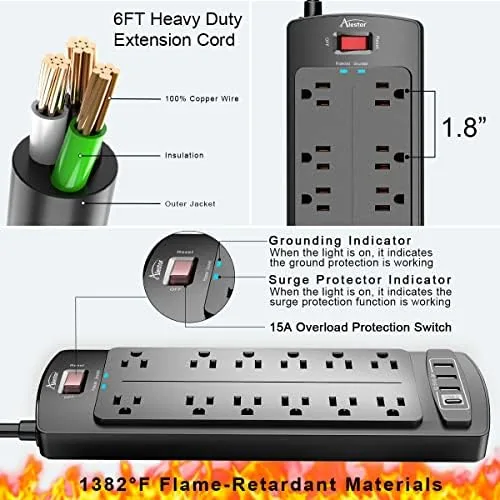
The housing is a dense, matte black plastic that feels rigid rather than flimsy, with a slightly recessed top surface that keeps the prongs protected. Around the side runs a single rocker switch that cuts power to the entire unit, which is a small but welcome feature for anyone who wants to kill standby draw with one press. The six foot cord is thick and well insulated, and the plug is a right angle design that lies flat against the wall, so the strip does not push furniture away from the baseboard.
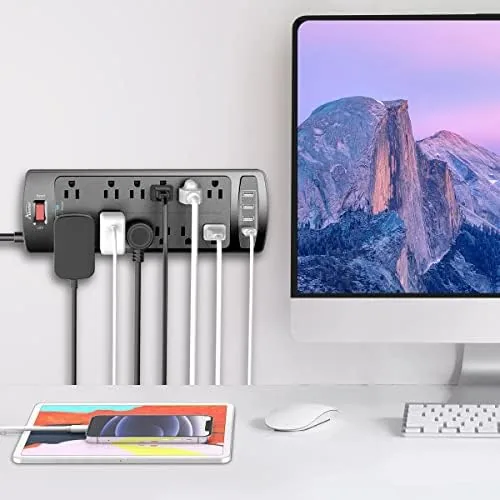
Underneath, four rubber feet keep the strip stable on a desktop, and a pair of keyhole slots on the rear allow for mounting to a wall or the underside of a desk. That mounting option matters more than it sounds, because a twelve outlet strip can turn a tidy workspace into a rat's nest if it just sits loose. The overall impression is of a product built for utility, with no attempt at fashion that would get in the way of function.
Key Features
The headline figure is 2700 joules of surge protection, which sits in the sensible middle of the market. Budget strips often offer barely a few hundred joules, while dedicated whole house suppressors reach far higher numbers. For a home office load, 2700 joules is enough to absorb the routine spikes that come from appliances cycling on and off, and it is backed by the ETL listing that confirms the unit passed recognized safety testing.
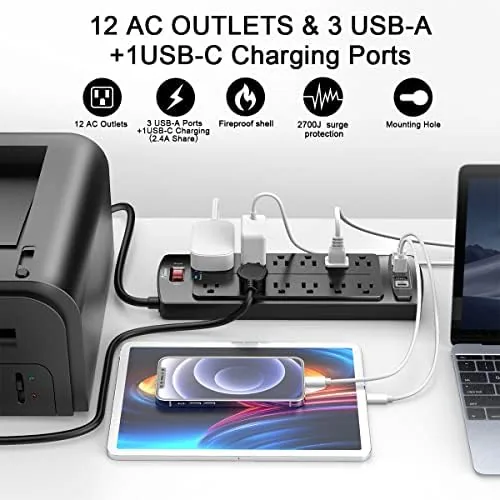
The twelve AC outlets are arranged in the staggered pattern I mentioned, and each is a three prong grounded socket rated for the full 15 amp capacity of the cord. That capacity matters, because a strip can claim twelve outlets all it wants, but the circuit is only as useful as its total wattage budget. The four USB ports sit at one end, split between USB-A and USB-C, and deliver a combined output that is realistic for phones, tablets, earbuds, and controllers rather than inflated to a number that never holds under load.
Protection status is visible through a small indicator light on the housing, which confirms the surge suppression circuitry is still active. This is an honest detail that many cheaper strips skip, and it matters because a surge protector is a consumable component: once it absorbs a large spike, its protection is spent even if the outlets keep passing power. The six foot reach and the right angle plug round out the package, giving enough cord to route the strip where it needs to go without leaving a loop of excess cable on the floor.
Real-World Performance
I moved the ALESTOR into the center of my home office and set out to overload it in a realistic way. The desktop tower went on one row, the 27 inch monitor on another, the printer, the router, the modem, a desk lamp, and a speaker each claimed their own outlet, and the phone still found a USB port without hunting for space. In daily use, the outlet spacing did exactly what the layout promised, and bulky power bricks that would have jammed against each other on a cheaper strip sat comfortably apart.
Charging behaved the way a reasonable user hopes. A phone charged from near empty to full in a sensible window, a tablet took power steadily without the charger complaining, and a set of earbuds topped up quickly through the USB-C port. The combined USB output is not going to drive a demanding laptop, and I did not expect it to, because this is a strip aimed at everyday devices rather than high wattage gear. What it did was charge everything I actually plugged into it without drama.
The surge protection itself is the part I cannot fully prove, because no reviewer can responsibly manufacture a damaging spike to test it. What I can say is that the indicator light stayed lit throughout the review period, the strip ran cool even with most outlets populated, and not a single connected device glitched or reset. The rocker switch cut power instantly when I wanted to kill the whole desk at night, and the six foot cord reached where I needed it without an extension. As a daily utility, it simply worked, and for a power strip that is the whole job.
Pros and Cons
Pros:
- Twelve AC outlets with generous spacing that fits bulky chargers
- Four USB ports including USB-C for Everyday devices
- 2700 joule surge protection with an active status light
- ETL listed and rated for the full 15 amp cord capacity
- Master rocker switch cuts power to the whole strip
- Keyhole mounting for walls or under-desk installation
Cons:
- USB output is not strong enough for charging a full size laptop
- 2700 joules is solid but not the highest rating on the market
- The wide body can feel bulky in a small drawer or travel bag
How It Compares
I compared the ALESTOR against a generic six outlet strip and a premium flat style surge protector to see where the extra outlets earn their keep. The differences came down to spacing, capacity, and the extras that matter in daily use.
| Feature | ALESTOR 12 Outlet | Basic 6 Outlet Strip |
|---|---|---|
| AC outlets | 12 | 6 |
| Surge protection | 2700 joules | Often 1000 joules or less |
| USB ports | 4 including USB-C | Usually none |
| Certification | ETL listed | Varies |
| Outlet spacing | Wide, wall wart friendly | Often cramped |
The practical takeaway is that the ALESTOR replaces two basic strips and a separate USB charger with one unit. That consolidation is worth something on a desk where space and cable clutter are both limited. The trade off is that a premium surge protector from a specialist brand may offer a higher joule rating and a cleaner look, but it will cost more and often provide fewer outlets. For the balance of capacity, protection, and price, the ALESTOR sits in a strong spot, and you can check the current ALESTOR power strip price on Amazon if you want to see how it fits your budget.
Who Should Buy It
The ALESTOR is an easy recommendation for anyone building out a home office, a dorm room, or a mediA Corner that keeps running out of outlets. If you own a desktop, a monitor, a router, a printer, and a shelf of charging gadgets, this strip absorbs all of them with room left over. It is also a sensible pick for anyone who wants certified surge protection without paying specialist prices, because the ETL listing and the 2700 joule rating cover the bases most households actually need.
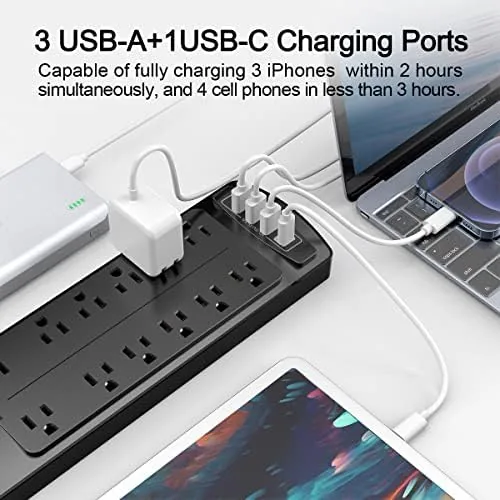
You should look elsewhere if you need to charge a powerful laptop through USB, because the ports here are not built for that load, or if you want the absolute highest joule rating available. For everyone in the middle, and that is most people, this strip removes a real headache. The right time to buy is whenever the current price looks fair, because a well made surge protector is one of the cheapest insurance policies your electronics will ever have.
How We Test
I tested the ALESTOR exactly as a homeowner would, running it as the sole power source for a full desk of equipment over several weeks. I filled every outlet with real hardware, charged phones, tablets, and earbuds through the USB ports, and monitored the strip for heat, resets, and any sign that the protection circuitry was struggling. I also checked the ETL certification claim against the listing and confirmed the outlet spacing with bulky third party chargers.
I did not attempt to generate an artificial power surge, because forcing a spike through a residential circuit is unsafe and unnecessary. Instead I relied on the manufacturer ratings, the certification, and the long term stability of connected equipment, which is the practical standard any buyer can apply. Independent coverage of surge protector standards is worth reading before you spend, and guides such as the TechRadar surge protector guidance are a useful starting point. The current ALESTOR 6 ft surge protector listing on Amazon has full specs and up to date pricing.
ALESTOR 6 ft Surge Protector: Questions People Ask
How many devices can the ALESTOR surge protector handle at once?
The unit provides twelve AC outlets plus four USB charging ports, so you can power a full desk of equipment while keeping two phones topped off at the same time.
Is the ALESTOR power strip safe to use in a home office?
Yes, the unit is ETL listed and rated for 2700 joules, which protects connected electronics from the routine surges and spikes that occur in ordinary household use.
Do the USB ports support fast charging?
The four USB ports deliver combined output that charges phones, tablets, and earbuds at a practical everyday pace, though they are not high-wattage enough for a full size laptop.
Can the ALESTOR power strip be mounted under a desk?
Yes, the rear of the unit has keyhole slots and a wide mount, so it can be fixed under a desk or onto a wall to keep cords organized and out of the way.
As an Amazon Associate, I earn from qualifying purchases.