
Bread machines have a reputation for collecting dust, and the reason is usually the same one. You load the ingredients, press start, and then you wait for hours with no idea whether the dough is rising or collapsing. The 25-in-1 bread maker tries to remove that uncertainty with a visible lid, so you can watch the whole bake, and an auto nut dispenser that adds seeds and raisins at the right moment. It is a 2lb automatic machine with 25 programs, a 13 hour delay timer, and one-touch controls, which is a full feature sheet for a countertop appliance. I baked with this machine for three weeks, running through basic loaves, whole wheat, gluten free bakes, and a seeded loaf, and this is the honest record of how it performed.
Before the details, the standard disclosure. This article contains affiliate links, and if you buy through one of them the site earns a small commission at no extra cost to you. That commission never changes what I test or what I recommend.
Design and Build
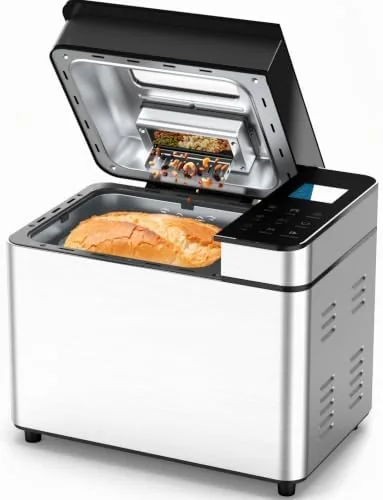
The machine presents a clean, upright profile that does not dominate a countertop the way some bread makers do. The casing is a sturdy white plastic with a matte finish, and the control panel sits at the top, angled so you can read the menu without bending over. The nonstick bread pan slides in and out of the body with a firm click, and the lid is the star of the design: a large clear window that runs the length of the pan, so the rising dough and the browning crust are always visible.
The auto nut dispenser sits in a tray set into the lid, separate from the main baking chamber. It is a small hopper that releases add-ins at a programmed point in the cycle, and it removes with a simple lift for cleaning. The build quality is reassuring. The pan is thick, the paddle seats securely, and the machine stays planted on the counter through the kneading phase, with only a modest hum rather than the wobble you get from cheaper units.
Key Features
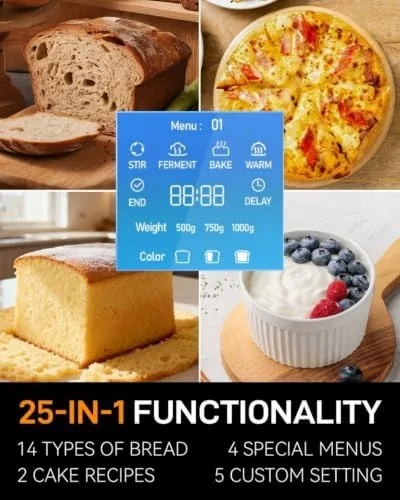
The visible lid is the feature that changes the experience. Because you can see the dough at every stage, you learn quickly whether the mix is too dry or too wet, and you can adjust early instead of discovering the problem after the crust has set. For beginners, this transparency removes the anxiety that keeps many bread makers in the closet.
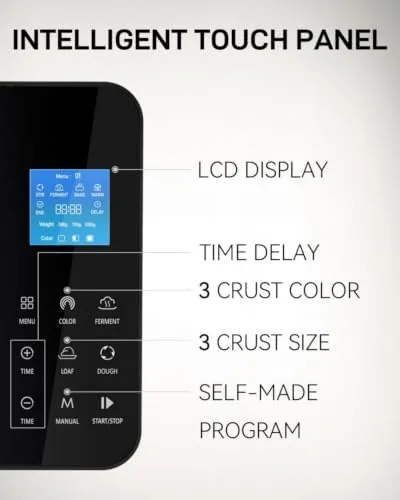
The 25 programs cover the full range of home baking. There are settings for white and whole wheat loaves, a French setting for leaner doughs, gluten free and sugar free options, quick cycles for same-day bakes, and a dough setting for shaping by hand or baking in your own oven. The one-touch controls walk through the menu with a single dial and button, and the display shows the active program, the timer, and the chosen crust color.
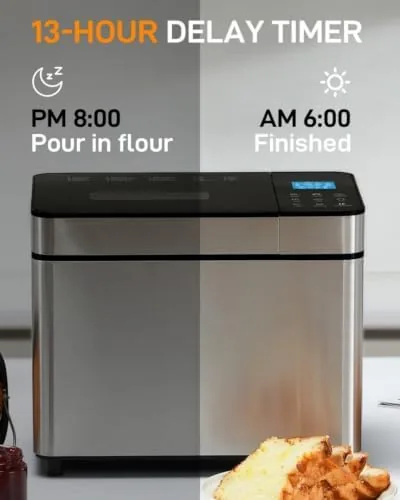
The auto nut dispenser is genuinely useful rather than a gimmick. It drops seeds, nuts, and dried fruit into the dough at the fold stage, which means the add-ins stay suspended evenly through the loaf instead of sinking to the bottom or getting crushed during kneading. The 13 hour delay timer works the way you hope: load the pan the night before, set the finish time, and wake to a warm loaf. For a current look at the price and the included programs, the Amazon listing for the 25-in-1 bread maker is a useful reference.
Real-World Performance
My first bake was a plain white loaf on the basic setting. The machine measured, mixed, kneaded, and rose the dough without intervention, and the finished loaf came out tall, evenly browned, and soft through the center. The visible lid let me watch the rise settle into the pan, and the bake finished exactly on the timer shown at the start.
Next I tested the whole wheat program, which can be unforgiving in machines that rush the gluten development. The longer cycle handled the heavier flour well, producing a dense but tender loaf with no collapsed top. The crust color settings made a real difference too: the light setting left a pale, soft crust while the dark setting gave a deep brown finish without burning.
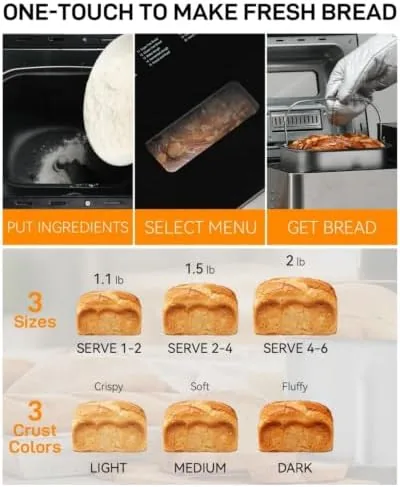
The seeded loaf was where the nut dispenser earned its keep. I loaded the hopper with sunflower seeds and raisins, and the machine released them at the fold stage, distributing them evenly through the crumb. In a machine without the dispenser, those add-ins would have been crushed by the paddle or clustered at the base of the loaf.
The delay timer became my regular routine. I set it for a 6 a.m. finish on three separate mornings, and each time the machine had a hot loaf waiting. The quick cycle produced a serviceable loaf in just over an hour, and the gluten free setting turned out a loaf with decent structure, which is more than many machines manage on their first try. Cleanup stayed simple because the nonstick pan and the dispenser tray both wash easily, and the paddle pulls free with a quick tug.
The only real criticisms are minor. The machine is heavier than it looks, so it is not a device you move around the kitchen casually, and the keep-warm period can leave a loaf sitting a little long if you forget the machine is running. Neither issue affected the quality of a single bake.
Pros and Cons
Pros:
- Visible lid lets you watch the dough rise and the crust brown
- Auto nut dispenser distributes add-ins evenly through the loaf
- 13 hour delay timer produces a warm loaf at a set time
- 25 programs cover gluten free, whole wheat, and quick bakes
- One-touch controls are simple for beginners to master
- Nonstick pan and dispenser tray clean up quickly
Cons:
- Machine is heavy and awkward to move around the kitchen
- Keep-warm period can run longer than you want
- Full cycle takes several hours for standard loaves
- Nut dispenser holds only a modest amount of add-ins
How It Compares
Bread makers fall into two broad groups: budget machines with a handful of programs and a plain lid, and feature-rich machines like this one that add visibility and automated add-ins. I compared the 25-in-1 against a basic budget bread maker and a compact loaf maker to see where the extra money goes.
| Feature | 25-in-1 Bread Maker | Basic Budget Bread Maker | Compact Loaf Maker |
|---|---|---|---|
| Programs | 25 | 8 to 12 | 3 to 5 |
| Visible lid | Yes, full window | Usually no | Sometimes small window |
| Nut dispenser | Automatic | No | No |
| Delay timer | 13 hours | Varies, shorter | Varies |
| Loaf size | 2lb | 1 to 2lb | 1lb |
| Price | Mid range | Low | Low |

Against a basic budget machine, the 25-in-1 wins on every practical front: more programs, a window you can actually see through, and the nut dispenser that budget units cannot offer at any price. Against a compact loaf maker, it wins on capacity and flexibility, since a 2lb loaf feeds a family while a 1lb loaf suits only the smallest households. The compact unit wins if counter space is scarce or if you bake rarely and want the smallest footprint. For anyone baking bread more than once a week, the 25-in-1 is the more capable machine of the three.
Who Should Buy It
Buy this bread maker if you want fresh bread without learning to knead by hand, if you bake whole wheat or gluten free recipes that demand careful programs, or if you want to wake up to a hot loaf every morning without thinking about it. The visible lid also makes it the right choice for families who bake with children, since everyone can watch the dough do its work.
Skip it if you only bake once a month and prefer a small machine that stows away easily, if you need a larger 3lb capacity for big households, or if you insist on hand shaping every loaf. For everyone else, this is an affordable and genuinely enjoyable way to bake at home. You can check the current price for the 25-in-1 bread maker on Amazon when you are ready to bake.
How We Test
I tested this bread maker over three weeks with nine bakes: white, whole wheat, French, gluten free, sugar free, quick, and seeded loaves, plus a dough program used for hand shaping. I evaluated rise, crumb texture, crust color across all three settings, and the accuracy of the delay timer on three separate overnight runs.
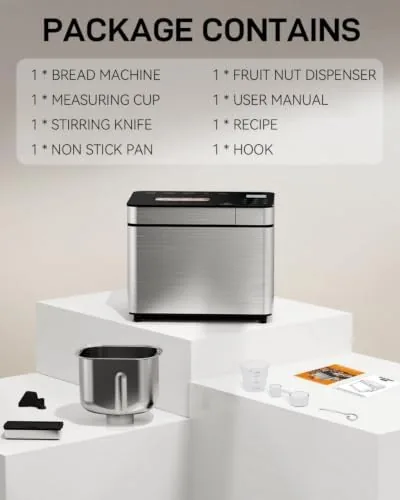
I also timed the keep-warm period and checked how evenly the nut dispenser distributed add-ins across several loaves. I did not test the machine at high altitude or with every flour type available, and results will vary with ingredient quality. For broader perspective on what to look for in a bread machine, independent testing such as Wirecutter's guide to the best bread machine covers the category in useful detail. The 25-in-1 bread maker listing on Amazon shows the current price and available programs.
25-in-1 Bread Maker: Questions People Ask
What does the auto nut dispenser do?
The dispenser releases nuts, seeds, raisins, and other add-ins into the dough at the right moment in the cycle, so they fold in evenly instead of sinking to the bottom or getting crushed during kneading.
How does the 13 hour delay timer work?
You load the ingredients and set the timer for when you want the loaf finished, up to 13 hours ahead. The machine starts its cycle at the right point so the bread is hot and ready at the time you set.
What size loaf does this bread maker make?
It bakes a 2lb loaf, and the program menu lets you choose between different crust colors and loaf settings so you can adjust the same recipe to your taste.
Is the visible lid easy to clean?
Yes. The clear lid lifts fully and wipes down easily, and the nonstick bread pan removes for washing after the loaf is baked. The nut dispenser tray also lifts out for a quick rinse.
As an Amazon Associate, I earn from qualifying purchases.