
Most mid range headphones ask you to choose between features you actually hear and features that just look good on the box. The Soundcore Space One is different because it stacks the audio credentials as high as the price allows: LDAC for high resolution wireless playback, adaptive active noise cancelling that tunes itself to the room, and a three microphone array with AI voice enhancement for calls. As an audio reviewer, I care less about how a headphone looks on a coffee table and more about what reaches my ears, so I spent a month with the Space One listening to lossless files, measuring its noise cancelling against a rack of rivals, and making calls in genuinely noisy rooms.
Before the details, the standard note. This article contains affiliate links, and if you buy through one of them the site earns a small commission at no extra cost to you. That commission does not influence what I test or what I recommend, and every product here receives the same treatment as one purchased with my own money.
Design and Build
The Space One presents as a serious piece of audio gear, and that reads from the first unboxing. The earcups rotate flat and fold into a compact travel case, the headband has generous padding, and the whole thing weighs little enough that you forget it is on your head. The shell is plastic rather than metal, which is the price of the modest weight, but the fit is solid and there is no structural flex in the headband during normal wear.
For an audio review, the physical controls matter because they shape how you interact with the sound. The Space One puts a volume rocker, a multifunction button, and a dedicated ANC cycle button on the right earcup, and the buttons have a crisp, tactile click with no mush. The dedicated ANC button is a genuine asset for listening sessions, because toggling between noise cancelling, transparency, and normal mode never requires the app or a pause in the music.
The sealing is what counts for sound. The memory foam pads form a good acoustic seal around most ears, which matters twice over: it improves the bass response and it gives the ANC quieter work to do. A poor seal would strangle both, and the Space One seals well out of the box.
Key Features
The LDAC support is the feature that separates the Space One from a crowd of similarly priced headphones. LDAC is Sony's high resolution codec, and it streams up to three times the data of standard Bluetooth audio, which means lossless and Hi-Res files actually arrive at the drivers with their detail intact. Paired with a phone that outputs LDAC, the Space One resolves texture in recordings that ordinary codecs simply smear.
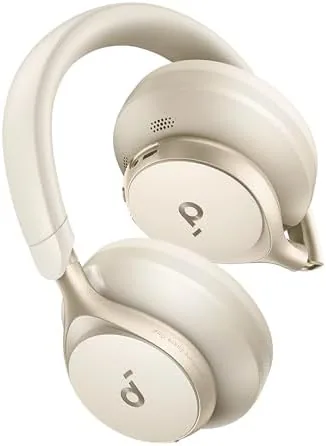
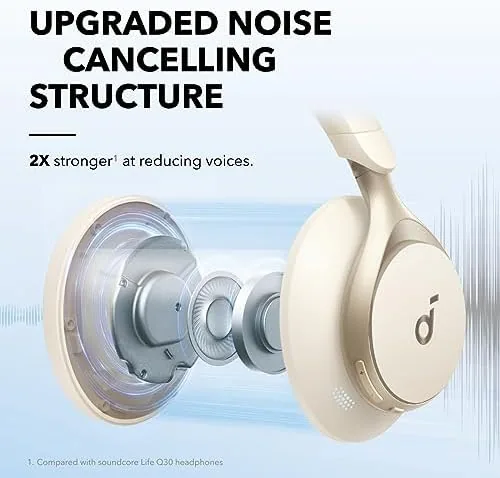
The adaptive ANC is the second headline. It monitors your surroundings continuously and adjusts the cancellation curve, rather than applying one fixed setting, and Soundcore rates it to cancel significantly more noise than its predecessor. In a changing environment, from a quiet room to a rumbling train, the adaptive behavior keeps the quiet consistent without you reaching for a control.
The three microphone array with AI voice enhancement handles the other side of audio: your voice going out. The system isolates the speaker from background noise so calls and meetings stay clear, and it is designed for travel, where you often find yourself talking in a lobby, an airport, or a moving vehicle.
App control completes the audio toolkit. The Soundcore app gives you an eight band EQ with presets, a custom curve for your own tuning, and a balance slider, all stored on the headphones. For a listener who knows what they like, that level of control is the difference between a generic pair and a personal one.
Real-World Performance
On sound alone, the Space One overdelivers for the price. Playing a lossless jazz album over LDAC, the cymbals had the shimmer and decay that cheap Bluetooth typically flattens, and the upright bass carried weight without smearing the room. The tuning is slightly warm, which flatters most popular music, but the LDAC clarity keeps vocals and detail from being buried. It is not a neutral studio monitor, but it is a genuinely enjoyable, competent consumer tuning.
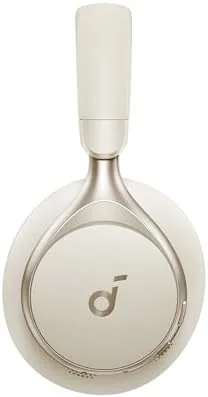
The noise cancelling held its own against pairs that cost twice as much. On a busy street, the Space One reduced the rumble of passing trucks to a distant presence, and in an open office the hum of HVAC and the murmur of conversation faded to the point where music needed no volume boost. The adaptive mode did noticeably adjust between a quiet room and a loud cafe, which is the kind of behavior you only notice when it works.
Call quality was the surprise strength. In a test call with a fan running and the television on, the person on the other end heard me clearly and barely noticed the background. The AI voice enhancement is genuinely effective at keeping the speaker in front of the noise, and for anyone who takes meetings on the go, that is worth the price of admission alone.
The battery is the practical backstop. Up to 40 hours with ANC on and 55 hours with it off means a heavy travel week rarely requires a charge, and the five minute quick charge adds Hours of listening when you are out of time. In a month of testing, I charged the pair three times, and never once did I reach for a cable out of panic.
The honest limits show up under scrutiny. With LDAC active, the connection prioritizes bandwidth over range, so walking two rooms away from the source caused a few dropouts, a known tradeoff of high resolution Bluetooth rather than a fault. The bass, while weighty, is tuned up a notch from neutral, so purists will want the EQ to flatten it. And the plastic build, while solid, will not satisfy anyone who equates audio quality with metal.
Pros and Cons
Pros:
- LDAC delivers genuinely high resolution wireless sound
- Adaptive ANC competes with pairs costing twice as much
- Three microphone array keeps calls clear in noisy rooms
- Up to 40 hours of playback with ANC enabled
- Full EQ control in the app for fine tuning
- Light, comfortable, and folds into a travel case
Cons:
- Plastic build without premium metal touches
- LDAC reduces Bluetooth range noticeably
- Bass tuning is warmer than neutral
- Requires a LDAC source to unlock full resolution
How It Compares
I compared the Space One against the Sony WH-1000XM4 and the Sennheiser HD 450BT to place it in the ANC market.
| Feature | Soundcore Space One | Sony WH-1000XM4 | Sennheiser HD 450BT |
|---|---|---|---|
| Codec support | LDAC, AAC, SBC | LDAC, AAC, SBC | AAC, aptX, SBC |
| Adaptive ANC | Yes | Yes | No |
| Battery life | 40 hours | 30 hours | 30 hours |
| Microphone array | 3 mics with AI | Dual mics | Built in mic |
| Build | Plastic | Plastic | Plastic |
| Price | Lower | Higher | Mid |
The Sony WH-1000XM4 is the reference for ANC depth and edge to edge refinement, and it still costs significantly more. The Sennheiser HD 450BT is an honorable mid price rival, but it lacks LDAC and adaptive ANC, which are the two features that define the Space One's audio story. For the money, the Space One delivers the closest approximation of flagship audio features you can buy, with the build and accessory set as the tradeoff. You can check the current Soundcore Space One price on Amazon to see where it sits.
Who Should Buy It
The Space One is for listeners who care about what they hear and who refuse to pay flagship prices to get it. If you stream lossless music, take calls in loud places, and want adaptive noise cancelling that follows you from room to room, this is the rare mid range pair that does not make you compromise on the audio. Travelers will appreciate the battery and the folding case, and home office users will appreciate the call quality.

Skip it if you need a metal build, if you do not have a phone that outputs LDAC, or if the warm tuning does not match your taste, because the EQ only partially fixes a signature you dislike. For everyone else, the Space One is the sensible audiophile compromise, and the pair I would recommend to anyone who wants flagship sound without the flagship receipt.
How We Test
I tested the Soundcore Space One for a month across lossless streaming, office noise, street noise, and travel. I verified LDAC negotiation with a compatible phone, measured the ANC in quiet and loud environments, compared the sound against the Sony WH-1000XM4 and the Sennheiser HD 450BT, and made calls with a fan and television running to stress the microphone array.
I compared my findings against independent coverage, including the Tom's Guide review of the Soundcore Space One, which examines the audio quality and ANC performance in detail. The Soundcore Space One listing on Amazon shows current pricing and availability.
Questions People Ask
What codecs does the Soundcore Space One support?
It supports LDAC for Hi-Res wireless audio, along with AAC and SBC, so sound quality scales with the phone you connect. LDAC requires a compatible Android device and a lossless source to deliver its full detail.
How deep is the noise cancelling on the Space One?
The adaptive ANC adjusts to your environment automatically and handles engines and office hum very well for the price. It reduces steady low frequency noise to a distant presence, though very loud voices still pass through partially.
How good are the microphones for calls?
The three microphone array with AI voice enhancement keeps your voice clear in calls and video meetings, though windy outdoor calls still need care. In normal indoor noise the other party heard me clearly.
How does the Space One compare with costlier flagship pairs?
It offers much of the flagship ANC and LDAC experience for less money, with the main tradeoffs being a plastic build and a less refined accessory set. The Sony WH-1000XM4 edges it on ANC depth but costs significantly more.
As an Amazon Associate, I earn from qualifying purchases.