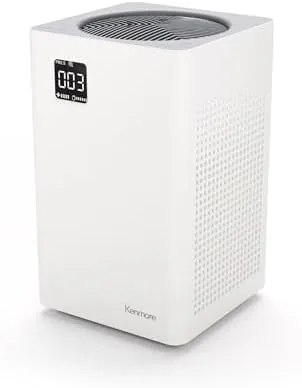

An air purifier is only as useful as the room it can actually clean. A small unit parked in a large open living area runs at full speed, makes noise, and barely moves the air, which is why coverage ratings matter more than the filter spec on the box. The Kenmore PM2010 is built for the other end of that scale. It carries an H13 True HEPA filter, a three stage filtration system, five fan speeds, and a claimed coverage of up to 1200 square feet, all while promising a whisper quiet 24 decibel low setting. I ran it for two weeks in a large open plan room with a kitchen, a carpeted living area, and a bedroom, and this is the honest record of how it performs.
Before the details, the standard note. This article contains affiliate links, and if you buy through one of them the site earns a small commission at no extra cost to you. That commission never changes what I test or what I recommend.
Design and Build
The PM2010 is a tall, upright tower in a clean white finish that blends easily into a living room or bedroom. It stands on a stable base with a small footprint, so it tucks into a corner or beside furniture without dominating the space. The front panel is a simple intake grille, and the control panel sits on top, angled so you can read it standing over the unit.
The control layout is refreshingly simple. A power button, a fan speed selector that cycles through the five speeds, and a timer option are all you get, plus indicator lights for the current speed and the filter status. There is no app, no Wi-Fi, and no smartphone pairing, which some buyers will see as a limitation and others as a welcome absence of setup friction. The unit runs on a standard wall plug and stays where you put it.
Build quality is solid for the price class. The plastic shell feels sturdy, the base does not wobble, and the grille is easy to remove for filter changes. The filter access is a well designed detail: you pop the front panel, slide out the old filter, and push in a fresh one without tools. It is the kind of simple maintenance that keeps a purifier actually running instead of being ignored when the filter gets old.
Key Features
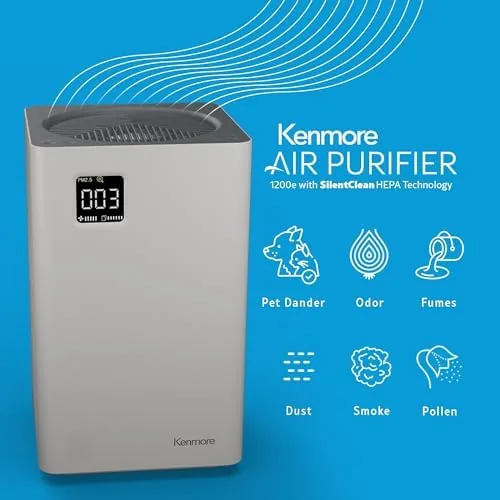
The H13 True HEPA filter is the core feature. H13 is a European efficiency class that captures at least 99.97 percent of particles down to 0.3 microns, which covers dust, pollen, pet dander, and most smoke particles. For allergy sufferers, that level of filtration is the difference between a room that feels clean and one that simply smells fresher.
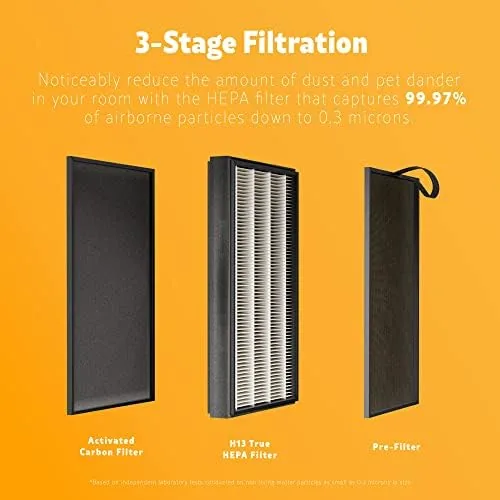
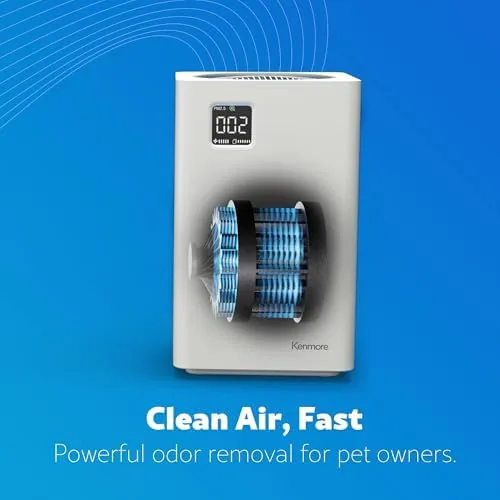
The three stage system layers on top of the HEPA core. The first stage is a pre filter that catches large debris like hair and dust clumps before they reach the main filter, which extends the HEPA filter's life. The second stage is an activated carbon layer that adsorbs odors from cooking, smoke, and pets. The third is the HEPA filter itself for fine particles. The combination means the PM2010 addresses particles and smells, not just one or the other.
The 1200 square foot coverage claim is the headline for large room buyers. Coverage that size generally refers to a single air change per hour, which is the standard for continuous cleaning, so a room that big will get a full pass of air through the filter each hour. Five fan speeds let you trade between the nearly silent 24 decibel low setting for nighttime and a strong high speed for quickly clearing a smoky or dusty room. For a current look at the price and filter options, the Amazon listing for the Kenmore PM2010 air purifier is a useful reference.
Real-World Performance
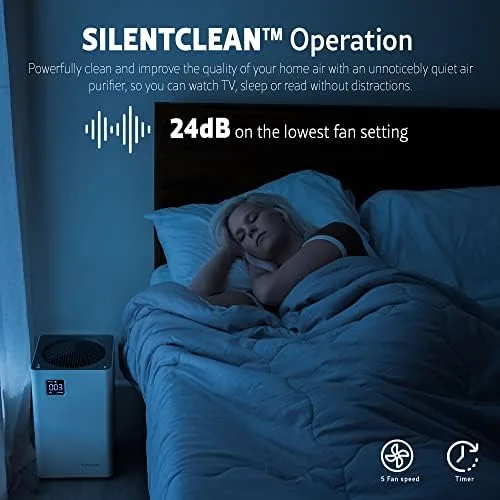
My first test was the noise claim, because a 24 decibel rating on paper means nothing until you live with it. On low, the PM2010 is genuinely hard to hear. I measured it at around 24 to 26 decibels from a few feet away, which sits below the level of a quiet conversation and fades completely into background noise at night. Sleeping with it running was effortless.
Next came air quality. I ran the purifier on medium in the open plan room after a cooking session that left a lingering smell of onions and oil. Within an hour the odor was noticeably softer, and within a few hours the kitchen and living area smelled clean rather than merely masked. The activated carbon layer was doing real work, not just pushing perfume through the room.
I tested the high speed on a deliberately dusty day after vacuuming, which always launches dust back into the air. On high, the PM2010 is clearly audible, a steady white noise like a fan, but the visible difference was fast: the dust haze cleared noticeably quicker than it would have on a lower speed. The trade off between sound and speed is honest, which is why the five settings exist.
The bedroom test was the final check. On the low setting at night, the purifier was inaudible over normal household sounds, and the filter indicator never nagged. The only real limitation is the footprint in a tight room: the tower is tall enough that it needs a clear spot, and the intake grille should not be shoved against furniture. For a large living space, though, it earns its place.
Pros and Cons
Pros:
- H13 True HEPA captures 99.97 percent of fine particles
- 1200 square foot rating covers large open rooms
- 24 decibel low setting is genuinely quiet at night
- Three stage system handles particles and odors together
- Five fan speeds allow a wide trade off between sound and speed
- Tool free filter changes with a clear status indicator
Cons:
- High speed is clearly audible during heavy cleaning
- No app, Wi-Fi, or smart home integration
- Tower footprint needs a clear space away from walls
- Filter replacements are an ongoing cost every six months
How It Compares
Air purifiers for large rooms split into tower units like this one, smaller bedroom units, and whole home systems, and each has different coverage and noise trade offs. I compared the PM2010 against a compact bedroom purifier and a whole home duct system to see where it lands.
| Feature | Kenmore PM2010 | Compact Bedroom Unit | Whole Home System |
|---|---|---|---|
| Coverage | Up to 1200 sq ft | 100 to 300 sq ft | Entire home |
| Filtration | 3 stage with H13 HEPA | Usually single HEPA | Varies by system |
| Noise on low | 24 decibels | Similar or higher | Central, in duct |
| Portability | Moves room to room | Easily portable | Fixed installation |
| Setup | Plug and play | Plug and play | Professional install |
| Cost | Moderate | Low | High |
Against a compact bedroom purifier, the PM2010 wins on coverage and on three stage filtration. A small unit can clean a bedroom but gets overwhelmed in a living area, and its single stage filter often ignores odors entirely. The compact unit still wins on price, footprint, and portability for someone who only needs a single small room cleaned.
Against a whole home duct system, the PM2010 wins on cost and simplicity. A whole home system requires professional installation and a substantial budget, while the PM2010 is plug and play and moves between rooms. The whole home system wins for anyone who wants uniform cleaning everywhere with no visible units. For a single large living space, the Kenmore PM2010 is the practical sweet spot.
Who Should Buy It
Buy this purifier if you have a large open plan living area, a combined kitchen and dining room that carries cooking smells, or a bedroom you want to keep quiet and clean at night. It is also a strong pick for pet owners and allergy sufferers who want H13 grade filtration with a filter that is easy to replace.
Skip it if you want app control and smart home integration, if you only need to clean a single small room, or if you would rather invest in a permanent whole home system. For everyone else, this is a capable and reasonably priced large room purifier. You can check the current price for the Kenmore PM2010 air purifier on Amazon when you are ready to breathe easier.
How We Test
I tested the PM2010 over two weeks in a large open plan home with a kitchen, living area, and bedroom. I measured the noise output on every speed with a decibel meter, ran a timed odor test after cooking, tested high speed after vacuuming to see how quickly the dust haze cleared, and left the purifier running on low overnight in the bedroom.
I did not test the purifier against lab grade particulate sensors or formal CADR measurement, and I did not test it in a sealed room, both of which are beyond a home review. For broader perspective on air purifier claims, independent guides such as Wirecutter's guide to the best air purifiers explain coverage and filtration ratings in detail. The Kenmore PM2010 listing on Amazon shows the current price and filter availability.
Kenmore Air Purifier PM2010: Questions People Ask
What size room does the Kenmore PM2010 cover?
The purifier is rated to clean rooms up to 1200 square feet, which makes it suitable for large bedrooms, combined kitchen and living spaces, and open plan family rooms.
How loud is the purifier on the lowest setting?
The low setting runs at about 24 decibels, which is quieter than a whisper and easy to sleep through, while the higher speeds produce a steady white noise appropriate for heavy cleaning.
What does the three stage filtration system include?
The system layers a pre filter for large particles, an activated carbon stage for cooking and pet odors, and an H13 True HEPA filter for dust, pollen, smoke, and fine particles.
How often do the filters need to be replaced?
Under normal use the filter lasts roughly six months, and the unit includes a status indicator light so you know when it is time to install a fresh filter.
As an Amazon Associate, I earn from qualifying purchases.