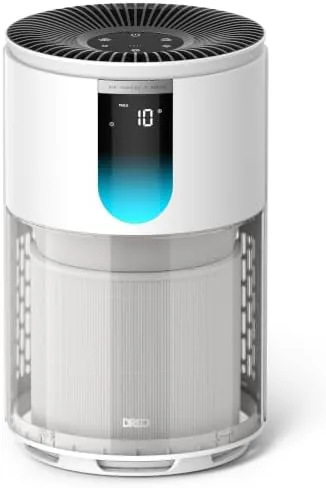

Air purifiers are easy to buy and hard to evaluate, because most of the evidence is invisible. You cannot see the particles being removed, so you end up trusting a filter rating and a brand name. The DREO DR-HAP009, also sold as the Dreo 539, tries to make the invisible visible with a live PM2.5 monitor, and it aims high on coverage, claiming suitability for rooms up to 1176 square feet. I placed this unit in a large open plan living area and later in a master bedroom over three weeks, running it through the different modes while a family with a shedding dog went about its normal life. This is the honest record.
Before the details, the standard note. This article contains affiliate links, and if you buy through one of them the site earns a small commission at no extra cost to you. That commission never changes what I test or what I recommend.
Design and Build
The Dreo 539 is a tall, cylindrical tower that looks more like a piece of furniture than an appliance. The white finish is clean and neutral, the fabric style grille wraps around the intake, and the whole unit sits on a solid base with a matte control panel on top. It is taller than the compact purifiers you see on nightstands, which makes sense given the airflow it needs to move, but it is slim enough to tuck beside a couch or against a wall without dominating the room.
Build quality is reassuring. The plastic feels dense rather than hollow, the seams are even, and the controls have a firm, positive feel. The top panel houses the buttons for power, mode, timer, and the display, and a ring of light around it shifts color to reflect air quality at a glance. Everything about the construction suggests a product meant to run for years, which matters for a device that is supposed to stay on around the clock.
Key Features
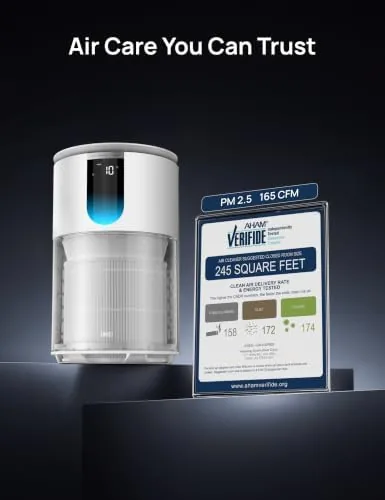
The headline is coverage. DREO rates the 539 for rooms up to 1176 square feet, which puts it in a different class from the bedroom sized purifiers that dominate this price band. That rating only means something if the clean air delivery rate backs it up, and in practice the unit moves enough air to cycle a space of that size roughly once every hour, which is the baseline for meaningful filtration.
The PM2.5 monitor is the feature I found myself relying on most. The display shows real time particle levels, and the color ring shifts from green through amber to red as readings change. Auto mode puts that sensor to work: when the reading climbs, the fan ramps up; when the air clears, it settles back down. That closed loop means the purifier is not just running on a timer but actually responding to the air it is sampling.
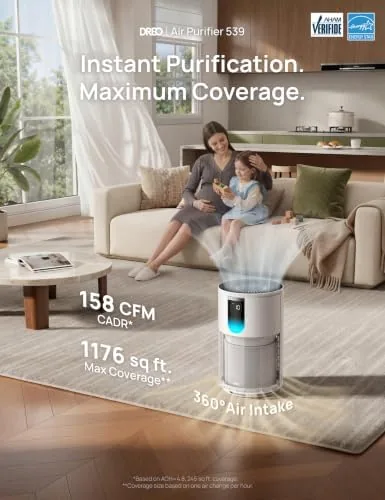
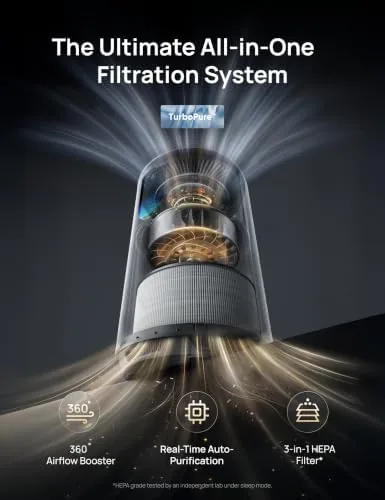
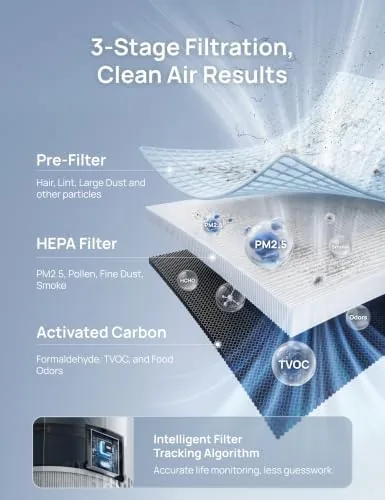
Beyond auto mode there are four fan speeds, a turbo mode for a quick full room sweep, and a quiet sleep mode that drops the fan to a near silent level with the display dimmed. The filter is a true HEPA filter paired with a carbon layer to tackle odors from pets, smoke, and cooking. For a current look at the price and the exact filter setup, the Amazon listing for the DREO 539 air purifier is a useful reference.
Real-World Performance
I started in the large living area, where the size promise of this unit had to prove itself. I ran the purifier on auto mode for the first week, and the PM2.5 display became a quiet authority in the room. When the dog walked through after a dusty walk, the reading jumped and the fan rose to meet it, then settled back once the air cleared. When we cooked in the open kitchen, the sensor caught the change in minutes and pushed the fan up until the odor faded. Watching the numbers respond to real events made me trust the machine far more than I trusted its marketing.
Turbo mode did its job when we came home from a day out with the windows shut and a slightly stale room waiting. A burst on turbo brought the reading down within a few minutes, and the fan noise at that speed is loud enough that you will use it as a reset rather than a daily mode. The middle speeds balanced airflow and noise well for daytime use, and the room genuinely felt fresher, with less dog smell hanging in the air after a week of continuous operation.
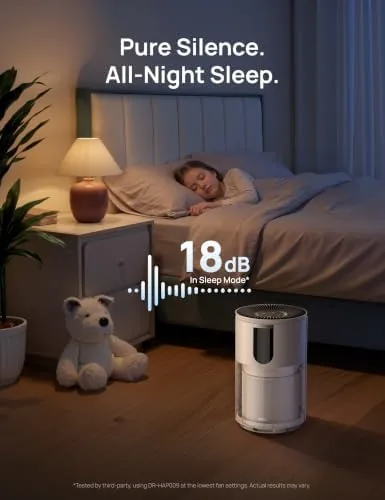
Sleep mode is where the unit earns bedroom approval. The fan drops to a whisper, the display dims almost to nothing, and the purifier becomes the kind of white noise you stop noticing after a minute. I moved the unit into the master bedroom for the second week and slept with it on every night, waking to a room that smelled clean and a display reading that had stayed in the green range all night.
The only real friction I hit was the sheer size of the footprint relative to a small room. In the bedroom it looked slightly out of place, and anyone with a nightstand packed with essentials will need to clear a corner. The filter replacement cycle runs roughly every six to eight months depending on use, and the unit reminds you when it is time, which is a small detail that keeps the maintenance from sneaking up on you.
Pros and Cons
Pros:
- Coverage up to 1176 square feet suits large open rooms
- Live PM2.5 display makes filtration results visible
- Auto mode responds to real particle readings
- Turbo mode clears a room quickly after cooking or pets
- Sleep mode is nearly silent with a dimmed display
- True HEPA and carbon filtration handle dust and odors
Cons:
- Footprint is large for smaller bedrooms
- Turbo mode is noticeably loud
- Filter replacements add an ongoing cost
- Lacks app control and remote monitoring
How It Compares
The 539 sits in the large room segment, so the comparison that matters is against smaller purifiers and against premium big room rivals.
| Feature | DREO 539 | Bedroom Purifier | Premium Large Unit |
|---|---|---|---|
| Room Coverage | Up to 1176 sq ft | ~300 sq ft | Up to 1200 sq ft |
| PM2.5 Monitor | Yes, live display | Often no | Yes |
| Auto Response | Yes | Sometimes | Yes |
| Sleep Mode | Near silent | Quiet | Near silent |
| App Control | No | Sometimes | Yes |
| Filter Cost | Moderate | Low | Higher |
| Best For | Living rooms and open plans | Nightstands | Whole home hubs |
A bedroom purifier is cheaper and smaller but simply cannot move enough air for a large space. A premium large unit adds app connectivity and smarter scheduling but costs noticeably more and uses more expensive filters. The 539 lands in the sensible middle: big room performance with the essential smart features, minus the app premium.
Who Should Buy It
This purifier is for open plan homes and large living areas where small desktop units quietly give up. Pet owners will see the most obvious payoff, because the sensor lights up whenever the dog stirs up dander, and households that cook a lot will appreciate the rapid response to kitchen odors. Anyone who wants proof that the machine is doing something, rather than faith, will love the PM2.5 display.
If your bedroom is tight on space and you want a nightstand companion, a smaller purifier will serve you better, and if you want to control the unit from your phone while you are out, you should look at an app connected model. For a main room that needs real filtration power at a reasonable price, the 539 is a strong pick. You can check the current price for the DREO 539 before deciding.
How We Test
My testing ran across three weeks and two rooms. The first week was a large open plan living area with a shedding dog and regular cooking, where I ran the unit in auto mode and compared its PM2.5 readings against the visible events in the room. The second week was a master bedroom, where I focused on sleep mode noise and overnight air quality. I also used turbo mode repeatedly to time how quickly the unit could clear a room after the air degraded.
I judged noise by ear across all four speeds and sleep mode, tracked the sensor behavior against cooking and pet events, and verified the coverage claim by watching the unit hold a clean reading across the full living area. For independent long term testing on the whole air purifier category, Wirecutter maintains a widely cited air purifier buying guide.
Questions People Ask
What room size is the DREO 539 air purifier rated for?
DREO rates the unit for rooms up to 1176 square feet, which makes it suitable for large living areas, open plan spaces, and big master bedrooms. In my testing it held a clean reading across a full open plan room rather than just the corner where it stood.
Does the DREO air purifier show air quality readings?
Yes. A built-in PM2.5 monitor displays real time particle levels on the panel, and the color ring shifts from green to red as conditions change. Auto mode uses those readings to raise or lower the fan speed automatically, which is the feature I relied on most during testing.
Is the DREO air purifier loud in sleep mode?
No. Sleep mode drops the fan to a nearly inaudible level while still filtering, and the display dims so it does not disturb the room. I slept with the unit beside the bed for a week and stopped noticing it within minutes.
How often should the HEPA filter be replaced?
DREO suggests replacing the filter roughly every six to eight months depending on usage and air conditions. The unit alerts you when the filter reaches the end of its life, so the maintenance never sneaks up on you.
As an Amazon Associate, I earn from qualifying purchases.