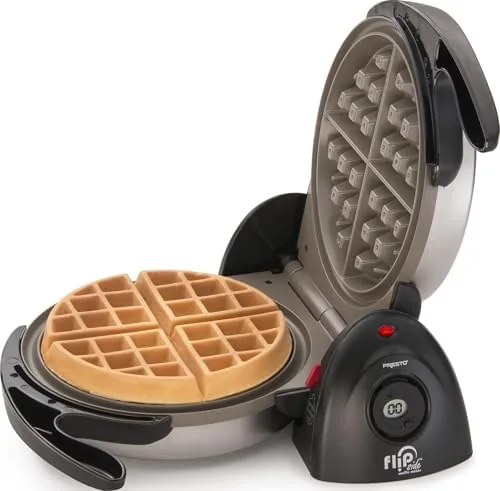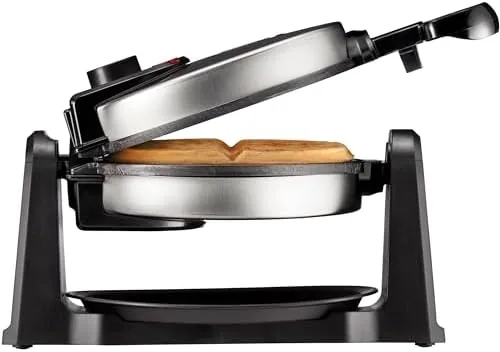

There is a reason so many people give up on homemade waffles: the batter goes into the middle of the plate, the heat hits the bottom first, and you end up with a waffle that is dark on one side and pale on the other. The Chefman Rotating Belgian Waffle Maker attacks that problem with a simple physical trick. The entire cooking unit is mounted on a hinge, and when you flip it 180 Degrees after pouring, gravity spreads the batter evenly across both plates while the heat works from both sides at once. I cooked with this machine every weekend for a month to find out whether the flip design really delivers the deep, even waffles it promises, and whether the rest of the package holds up to regular breakfast duty.
Before the details, the standard note. This article contains affiliate links, and if you buy through one of them the site earns a small commission at no extra cost to you. That commission never changes what I cook, how I test, or what I recommend.
Design and Build
The Chefman has the look of a serious appliance. The body is a brushed stainless steel and black combination that sits comfortably in a modern kitchen, and the unit is solid in the hand, with a substantial base that stays planted on the counter while you flip the cooking plates. Nothing about the construction feels cheap, which is a pleasant surprise at this price point.

The hinge is the heart of the design. It is a smooth, damped rotation that flips the closed cooking chamber through 180 degrees without slamming or rattling. The plates stay locked together during the flip, so there is no risk of batter escaping mid-rotation, and the unit settles level on the opposite side. After a month of repeated flips, the hinge showed no looseness or wear.
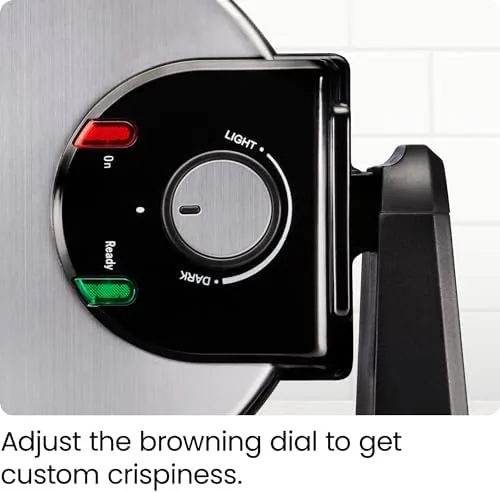
The controls are refreshingly straightforward. A single dial sets the browning level, which doubles as a timer, and an indicator light tells you when the plates are hot and when the waffle is done. There is no app, no touchscreen, and no digital menu to fight with, which is exactly what a weekend waffle maker should be. The locking lid is a practical touch, letting the whole unit close flat for storage, and the included drip plate catches any batter that escapes during cooking.
Key Features
The 180 degree flip mechanism is the feature that defines this machine, and it earns its keep. Because the batter is spread by rotation rather than by hand, you get a full, even coverage across a deep Belgian plate without having to guide the batter with a spatula. The deep pockets hold syrup and butter well, which is the whole point of a Belgian waffle.
The adjustable timer and browning dial give real control over the result. At the lowest setting, the waffles come out pale and soft, ideal for kids who like a gentle waffle with jam, and at the higher settings they turn a deep golden brown with a crisp exterior and a fluffy center. I found a middle setting produced the best all-around waffle, but the range is wide enough to please different tastes in the same household.
The non-stick plates are the third feature that matters. Waffles released cleanly in every one of my tests, and cleanup was a quick wipe with a damp cloth rather than a soak in the sink. The plates are not removable, which is the one structural limitation, but the non-stick surface is good enough that it never became an issue.
The locking lid and drip plate round out the package for storage and mess control. When closed and locked, the unit stands on its end, so it tucks into a cabinet slot without taking up a whole shelf. You can check the current price for the Chefman rotating waffle maker on Amazon to see how it compares with other flip irons.
Real-World Performance
I started with a basic buttermilk waffle recipe, the sort most households will make first. I poured the batter into the center of the lower plate, closed the lid, and flipped the unit. The rotation spread the batter into every corner of the plate, and when the timer sounded, the waffle lifted out intact with deep, uniform pockets and no pale patches. The evenness was the immediate, obvious win.
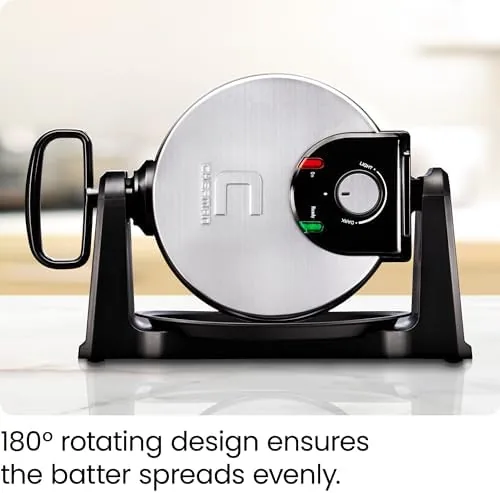
The browning control proved genuinely useful. One weekend I cooked two batches back to back, one at the low setting and one at the high setting, and the difference was dramatic. The low batch was soft and pale enough for a child's breakfast, and the high batch came out dark, crisp, and almost caramelized. The dial does not just change the time, it meaningfully changes the texture, which is the mark of a well-designed timer.
I also tried a denser whole-grain batter, which is where cheap waffle irons usually struggle because the batter does not spread well on its own. The flip mechanism handled it easily, spreading the thick batter evenly across the plate without leaving a thick blob in the center. That single test convinced me the flip design is not a gimmick, it is a real advantage for real recipes.

Heat recovery between batches was solid. The indicator light cycled back to the ready state within about a minute between waffles, which meant a family of four could be served in a single sitting without a long wait between rounds. The only honest complaint came from the non-removable plates: they are easy to wipe clean but impossible to soak, so any batter that bakes onto the edges over years of use will need careful scrubbing rather than a deep clean.
Pros and Cons
Pros:
- Flip mechanism spreads batter evenly for uniform waffles
- Deep Belgian pockets that hold syrup and toppings well
- Adjustable browning dial that changes texture, not just time
- Non-stick plates release waffles cleanly and wipe down easily
- Locks flat and stands upright for compact storage
Cons:
- Plates are not removable for deep cleaning
- Flip action needs a little care to keep the unit level
- Heat-up time between batches could be faster
How It Compares
To see how the Chefman stacks up, I compared it against a classic non-rotating Belgian waffle iron and a premium rotating model that costs roughly twice as much.
| Feature | Chefman Flip Iron | Classic Belgian Iron | Premium Rotating Model |
|---|---|---|---|
| Rotating flip design | Yes | No | Yes |
| Browning control | Adjustable dial | Fixed or simple dial | Adjustable |
| Even coverage | Excellent | Relies on hand spreading | Excellent |
| Plate release | Good non-stick | Good non-stick | Excellent |
| Storage | Locks flat, stands upright | Bulkier | Locks flat |
Against the classic Belgian iron, the Chefman wins on evenness and control. The non-rotating model produced acceptable waffles when I carefully spread the batter by hand, but it could not match the consistent coverage the flip delivered every single time. Against the premium rotating model, the Chefman came surprisingly close, matching the core flip behavior with slightly less premium build refinement, at a fraction of the price. For most households, the Chefman is the best value of the three, because it delivers the feature that matters, the flip, without the premium markup.
Who Should Buy It
Buy this waffle maker if you cook for a family on weekends, if your old iron always produced uneven waffles, or if you want deep Belgian pockets without paying premium prices. It is also a smart pick for anyone short on cabinet space, because the locking lid and upright storage make it one of the most kitchen-friendly waffle makers around.
Skip it if you only make waffles a few times a year and already have an iron that works, or if you insist on removable plates for the easiest possible cleaning. For everyone else, this is the flip iron to buy. You can see the current price for the Chefman waffle maker on Amazon when you are ready to upgrade your breakfast setup.
How We Test
I cooked with the Chefman every weekend for a month, testing buttermilk waffles, whole-grain batters, and the full range of the browning dial. I timed heat-up and recovery between batches, watched the flip mechanism for wear, and judged evenness, pocket depth, and ease of release for every waffle.
I compared the unit side by side with a classic non-rotating Belgian iron and a premium rotating model to understand where the value actually sits. Independent guidance such as Wirecutter's guide to the best waffle makers is a useful companion for comparing flip irons against the wider market. The Amazon listing for the Chefman rotating waffle maker shows the current price and shipping details.
Chefman Rotating Waffle Maker: Questions People Ask
Do you have to rotate the Chefman waffle maker while cooking?
Yes. The unit is designed to be flipped 180 degrees after pouring the batter, which spreads it evenly across both plates and produces deeper pockets.
What does the adjustable timer do?
The dial sets the cooking time and browning level, so you can go light and soft or dark and crisp, and the indicator light shows when the waffle is ready.
Are the waffle plates non-stick?
Yes. The plates have a non-stick coating, and waffles released cleanly in testing, though a light brush of oil keeps the coating happy over years of use.
Does the waffle maker store upright?
The locking lid lets the unit close flat and stand upright for storage, and the drip plate catches any batter that escapes the plates.
As an Amazon Associate, I earn from qualifying purchases.