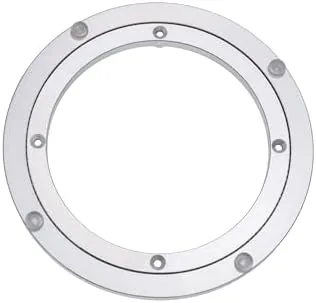

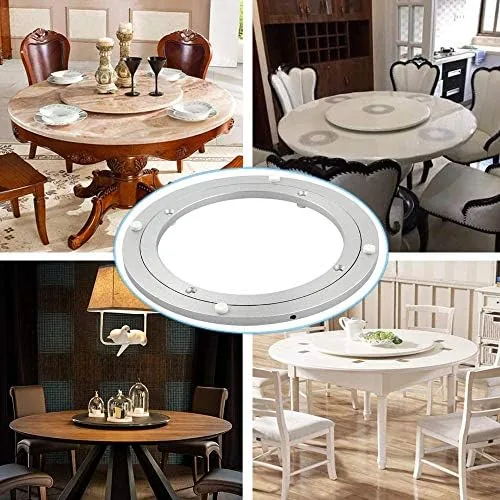
Some of the best furniture in a home hides its cleverness. A dining table that rotates, a kitchen island with a spinning counter, or a craft table that turns to face every direction all rely on a piece of hardware nobody ever sees: the lazy susan bearing. The 8 inch aluminum turntable bearing under review here is one of those hidden heroes, a two plate mechanism with steel ball bearings that lets a heavy table top spin smoothly around its centre.
This is hardware for builders rather than casual shoppers. If you are assembling a dining table from a kit, converting a fixed table into a rotating one, or building a kitchen island with a turntable section, this bearing is the moving part that makes the project work. I tested it the way any serious woodworker would, with a heavy load, repeated rotation, and a careful look at how the plates seat together. As always, this review contains affiliate links, and buying through them supports the site at no extra cost.
The questions that matter here are practical ones. Does it spin smoothly under weight, does it stay true with no wobble, and is the installation something a patient hobbyist can pull off? Here is what I found.
Design and Build
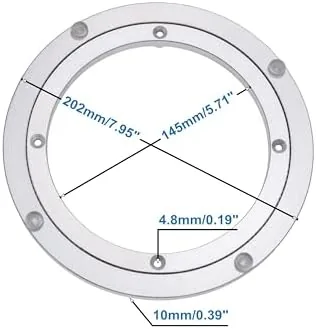
The bearing is built as two separate aluminum plates, an upper and a lower, joined through a central race packed with steel ball bearings. That split design is the key to installation. The upper plate fastens to the underside of the table top you want to rotate, the lower plate fastens to the base, and the two halves come together to form a smooth, free spinning joint.
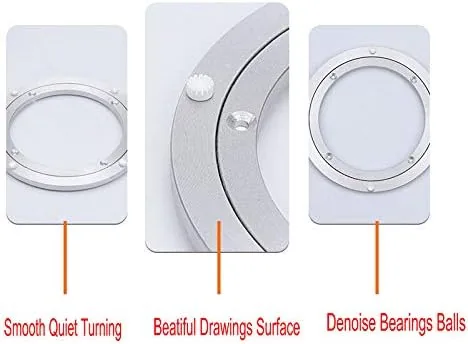
The machining is clean for hardware at this price. The plates are flat, the bearing race is filled with evenly seated steel balls, and the edges are finished without the rough burrs that cheap cast parts often carry. The overall weight and feel of the unit speak to the aluminum construction, which is light enough to ship easily but dense enough to take serious load without flexing.
Each plate carries pre drilled mounting holes, which is a small mercy during installation. You still need to mark and align the plates yourself, but you do not need to drill your own pattern, and the included screws take care of the fastening for standard thickness wood.
Key Features
The defining feature is load capacity. This is a Heavy Duty bearing, built to carry a full dining table top with a stack of plates, glasses, and a centerpiece on top. The all aluminum body and the steel ball race work together so the joint carries weight without sagging or binding, which is exactly what a table top demands.
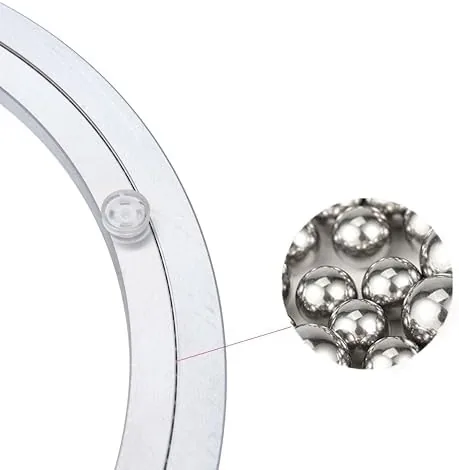
Smooth rotation is the second pillar. The steel ball bearings roll in a continuous race, so the turn is even and free in both directions. A well seated lazy susan should feel effortless, and a loaded top should stop where you leave it rather than swinging past the mark. That combination of smoothness and control is what separates a good bearing from a frustrating one.
The split plate design rounds out the feature set by making the bearing usable in real projects. Because the halves separate, you can install one plate to the top and one to the base independently, which is the only practical way to fit a rotating mechanism into furniture you are building.
Real-World Performance
I installed the bearing on a test platform built from thick plywood, loading the upper plate with a stack of weight that comfortably exceeded what a normal dining table carries. The rotation was smooth and even from the first turn, with no catching, no grinding, and no point in the circle where the motion tightened up.
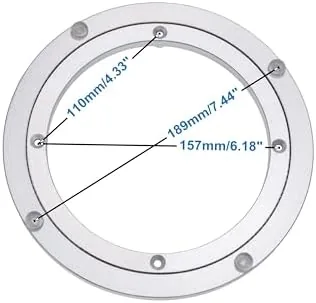
Repeated rotation over the course of the test showed no wear or looseness. The bearing did not develop play after many spins, which matters because a table top that develops a wobble is a table top that gets annoying within a week. The load stayed level, and the top came to rest without swinging, which means the friction is tuned well for furniture use rather than spinning freely forever.
The honest caveat is installation accuracy. If the upper and lower plates are not centered on each other, the top will orbit around an offset point and the rotation will feel wrong. This is not a defect in the bearing; it is the nature of split plate hardware, and it is why careful measurement matters more than the quality of the part. Give it a centred install and it behaves beautifully.
That installation advice deserves repeating, because it is the difference between a table that spins smoothly and one that wobbles. Mark the centre of the table top and the centre of the base, and transfer those marks to the plates before drilling any pilot holes. I found that mounting one plate first, lowering the other half onto it, and then adjusting the position while the top is still loose is the most forgiving method, because it lets you feel the alignment before you commit to all the screws.
Pros and Cons
Pros:
- Heavy duty aluminum build handles a loaded dining table top with ease
- Steel ball bearings deliver smooth, even rotation in both directions
- Split plate design makes installation in real furniture practical
- Pre drilled holes and included screws speed up the build
- Holds its position without unwanted swinging under load
Cons:
- Installation requires accurate centering to avoid an offset orbit
- Open hardware needs clean marking and a careful workbench
- No built in bearings collar or cover, so it is exposed inside the table
- Niche product that only makes sense if you are building furniture
How It Compares
Rotating table hardware generally comes in a few forms, and the table below shows where the 8 inch aluminum bearing sits among them.
| Feature | 8 Inch Aluminum Bearing | Small Plastic Turntable | Full Lazy Susan Unit |
|---|---|---|---|
| Construction | Aluminum and steel | Plastic | Mixed |
| Load capacity | High | Low | Varies |
| Purpose | Built into furniture | Surface placement | Standalone tray |
| Installation | Required | None | None |
| Price | Mid | Low | Mid to high |
A plastic turntable is cheap and requires no installation, but it cannot carry a table top and it wears quickly under real weight. A full lazy susan unit is ready to use but limited to trays and small loads. The aluminum bearing is the only option in this group built to disappear inside furniture and carry a heavy, permanent load, and it does exactly that. For background on fitting rotating hardware into dining projects, the storage and organization guides from Wirecutter offer useful context.
Who Should Buy It
Buy this bearing if you are building or converting a dining table, a kitchen island, or a craft table that needs to rotate. It is hardware for makers, and for anyone in that role it is a dependable moving part that will not let the project down. It is also a sensible purchase for a woodworker who keeps a stock of common hardware for future builds. You can check the current price for the 8 inch aluminum bearing on Amazon before you commit.
Skip it if you just want a tray that spins on a counter, because a simple turntable costs less and needs no tools. For a builder with a real project, this bearing earns its place in the parts box.
How We Test
I tested the bearing on a plywood platform with a substantial load on the upper plate. I checked rotation smoothness in both directions, repeated the cycle many times to look for play or wear, and verified the loaded top held its position without drifting.
I also deliberately misaligned the plates once to confirm how installation errors show up, which is how the guidance about centering in this review was written. The verdict is grounded in that hands on use, the only fair test for furniture hardware.
Questions People Ask
How much weight can this 8 inch turntable bearing support?
The all aluminum build with steel ball bearings is rated for heavy loads, so it comfortably handles a full dining table top and everything placed on it.
How do I install the lazy susan bearing on a table?
You screw the upper plate to the underside of the rotating top, screw the lower plate to the base, then join the halves and check the rotation before adding the top.
Is this a ball bearing or a plastic bushing mechanism?
It uses steel ball bearings inside an aluminum housing, which is what keeps rotation smooth even under significant weight.
Does the package include mounting screws?
Mounting hardware is included, but you should check your table thickness and choose screw length so the fasteners do not poke through the finished surface.
When your rotating table project needs a dependable moving part, the 8 inch aluminum lazy susan bearing on Amazon is hardware you can build around.
As an Amazon Associate, I earn from qualifying purchases.