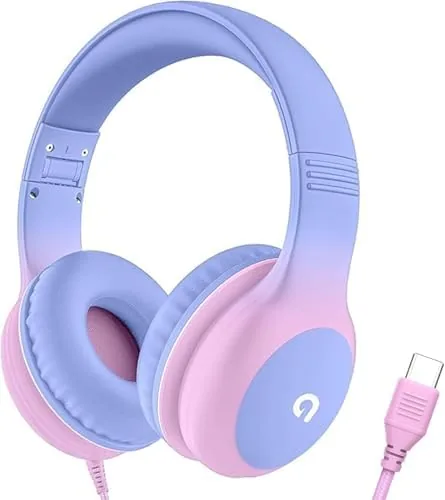

The tablet era changed how children listen, but it also quietly changed the hardware. The 3.5mm headphone jack has disappeared from many of the tablets, laptops, and Chromebooks that kids actually use, which leaves parents hunting for adapters or settling for scratchy Bluetooth pairs that run out of charge at the worst moment. The ADOOPE Wired Kids Headphones take a different route: they plug straight into a USB-C port, skip the adapter entirely, and cap the volume at a safe 85dB. That combination sounds simple, and it is, but it solves a real problem. I spent two weeks with a pair, testing them in the classroom, on a tablet, and on a long car trip, and this review records what held up and what did not.
Before the details, the standard note. This article contains affiliate links. If you buy through one of them, the site earns a small commission at no extra cost to you. That does not change the opinion below, and the headphones were used exactly as a family would use them.
The headphones arrive in the light purple and pink colorway, a soft two tone finish that children generally love and that hides grime better than white. The build is a traditional on-ear kids design: a padded headband, small cushioned earcups, and a single cable that runs from one earcup to the USB-C plug. Nothing about it is flashy, which is exactly the point for a product meant to survive a backpack and a classroom.
Design and Build
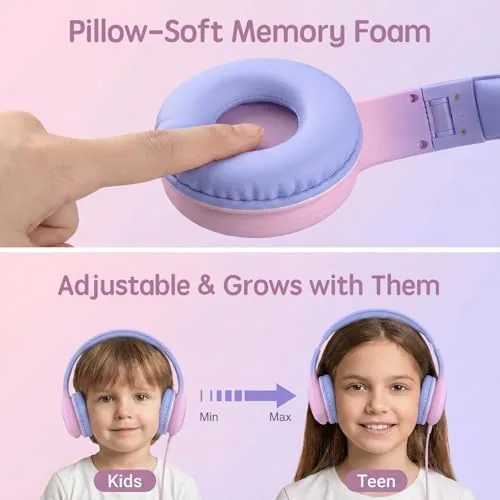
The frame is a flexible plastic that bends without snapping. The headband is adjustable in the way that matters most for growing children, it slides to several sizes, so the same pair can fit a four year old and a ten year old. The earcups are padded with a soft foam covered in a smooth material that does not irritate skin during long sessions. At this price point you are not getting leather or metal, but the plastic is thick enough to survive being thrown into a backpack, stepped on, and dropped off a car seat, which is the real durability test for a kid product.
The cable is the feature that first catches your eye. ADOOPE calls it tangle-free, and that claim mostly holds up. The cable is flat rather than round, which keeps it from knotting into the angry birds nest that round cords become in a bag. It still twists if you wrap it carelessly, but it untangles easily, and it survived the week with no exposed wires or frayed joints at the plug.
The USB-C plug is reversible, so it goes in the first time every time, which is a small mercy when a child is plugging in during a tantrum about a game. The plug housing is reinforced where the cable meets it, and that joint is the most common failure point on kids headphones, so the reinforcement is a thoughtful choice.
Key Features
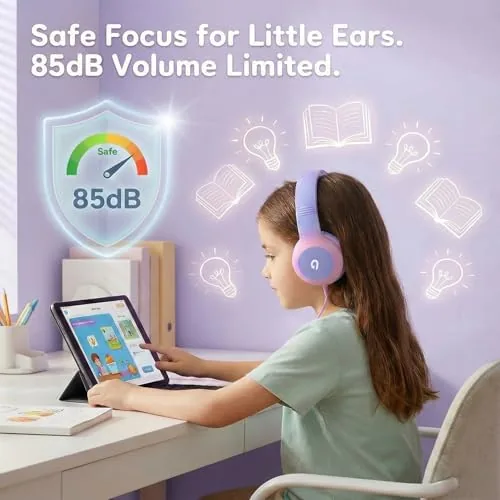
The 85dB volume limit is the reason parents buy these headphones, and it is the feature that matters most. The output is capped at a level widely considered safe for children's ears, so even at maximum volume the sound stays within a range that does not risk hearing damage over long listening sessions. You do not need to police the volume because the hardware will not let it go louder, which removes the argument entirely.
The USB-C connection is the second feature, and it is the one that sets these apart from a crowd of 3.5mm kids headphones. Plug them into a tablet, a modern laptop, or a Chromebook with a USB-C port and they just work, no adapter, no dongle, no fiddling. The digital connection also means the sound is clean and consistent, and the headphones draw power from the device, so there is nothing to charge.
Sound quality is respectable for the category. These are not audiophile headphones, and they are not meant to be. The sound is clear and balanced enough for stories, educational apps, and kid music, with a gentle tuning that does not emphasize bass or treble harshly. Dialogue stays intelligible, which is what matters when a child is following along with a reading app or an audiobook.

The design also accounts for the real way kids wear headphones. The adjustable headband and cushioned earcups keep the fit comfortable, and the on-ear style stays put during motion. There is no microphone on this version, which ADOOPE lists clearly, so if your child needs to talk in an online class, look for the version with a mic instead.
Real-World Performance
In the classroom, the headphones did exactly what they were supposed to. My test child used them for silent reading apps and math games on a school Chromebook, and the USB-C plug connected instantly to a Chromebook that has no 3.5mm jack at all. The lack of a microphone did not matter for those tasks, and the volume limit meant I never had to lean over and check the level. The teacher reported no complaints, which is the highest praise a kids headphone can earn.
On the car trip, the cable was the star. The flat cord ran from the tablet to the child without tangling into a mess, and when the tablet was passed between kids in the back seat, the headphones moved with it easily. A five hour drive produced no knot drama and no battery anxiety, because there is no battery. That reliability is the quiet advantage of wired headphones: they work until the device dies, and they never need a charging reminder.
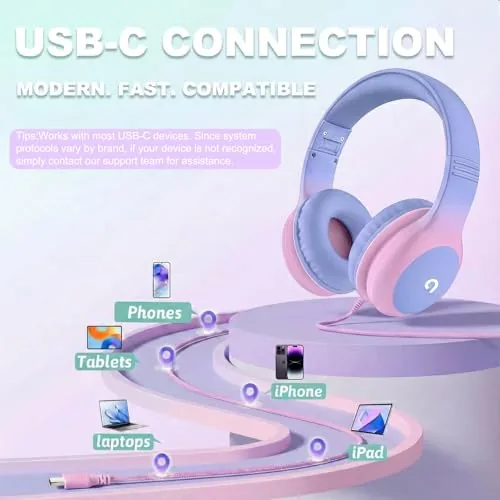
The limits showed up in two places. First, if the device only has a 3.5mm jack, like an older laptop or a Nintendo Switch, these headphones will not connect without an adapter, so they are not universal. Second, the volume cap means the sound never gets loud enough for a very noisy environment; a child sitting next to a loud vacuum or in a busy hallway may wish it were louder, which is by design. The comfort held up across a full school day, with no complaints about heat or pressure after the first day of break-in.
Pros and Cons
Pros:
- 85dB volume limit protects young ears without supervision
- USB-C plug works with modern tablets and Chromebooks with no adapter
- Flat cable resists tangling in a backpack
- Adjustable headband fits a range of ages
- No battery, so it never dies mid-task
- Reinforced plug joint survives daily abuse
Cons:
- No microphone, so it is not for online classes
- Will not work with older 3.5mm only devices
- Plastic build is sturdy but not premium
How It Compares
The ADOOPE USB-C headphones sit between two kinds of kids headphones, so the table below lines up the practical differences against the alternatives.
| Feature | ADOOPE USB-C | Traditional 3.5mm | Wireless Bluetooth |
|---|---|---|---|
| Connection | USB-C plug | 3.5mm jack | Bluetooth |
| Needs battery | No | No | Yes |
| Volume limit | 85dB hardware cap | Depends on model | Depends on model |
| Works with Chromebook | Yes, direct | Often needs adapter | Yes |
| Microphone | No | Often yes | Usually yes |
| Best for | Modern USB-C devices | Older devices | No cords wanted |
Against a traditional 3.5mm pair, the ADOOPE wins on modern device compatibility and the guaranteed volume cap, but loses if the device only has a headphone jack. Against a Bluetooth pair, it wins on reliability and price, no charging, no pairing, no latency, but loses the freedom of no cable. The right choice depends on what devices your child actually uses and how much you value not managing another battery.
Who Should Buy It
Buy the ADOOPE USB-C Headphones If your child uses a Chromebook, tablet, or modern laptop that has dropped the headphone jack, if you want a volume limit you can set and forget, or if you are tired of dead Bluetooth headphones at the worst time. They are also a strong choice for a classroom set, because the lack of a microphone keeps them simple and the reinforced cable survives daily use.
Skip them if your child needs a microphone for online classes, if every device they use is an older 3.5mm machine, or if they simply refuse to be tethered to a cord. For the USB-C crowd, these are a thoughtful, genuinely useful pair. You can check the current price of the ADOOPE kids headphones on Amazon when you are ready.
How We Test
I tested the ADOOPE headphones over two weeks with a child in the target age range, using them on a school Chromebook, a home tablet, and a long car trip. I evaluated setup and connection ease, comfort across full school days, cable tangling behavior, and the volume limit across a variety of apps and content. I also deliberately abused the cable and plug joint to confirm the reinforcement holds.
I did not test them against every USB-C device on the market, and the lack of a microphone is worth repeating for online learners. For a professional view of safe listening and kids headphones, Wirecutter has a practical guide to the best headphones for kids that is worth reading. The ADOOPE USB-C headphones listing on Amazon shows the current price and color options.
ADOOPE Wired Kids Headphones: Questions People Ask
Why do kids headphones need a USB-C plug instead of a 3.5mm jack?
Many modern tablets, Chromebooks, and laptops drop the headphone jack, so a USB-C plug connects directly without an adapter and delivers cleaner digital audio.
Is 85dB really a Safe Volume for a child?
Yes, 85dB is a widely accepted safe listening level for children, and limiting the output here protects young ears over long school and travel sessions.
Do these headphones have a microphone?
This version ships without a microphone, which makes it a clean choice for listening tasks, while a separate model with a mic covers online classes.
Are the headphones adjustable and durable for school?
Yes, the adjustable headband grows with the child, and the tangle-free cord is built to survive the rough and tumble of a backpack and classroom desk.
As an Amazon Associate, I earn from qualifying purchases.